9995 stories
·
100 followers

Republicans Learn X Is the Echo Chamber

1 Share
Republicans Learn X Is the Echo Chamber

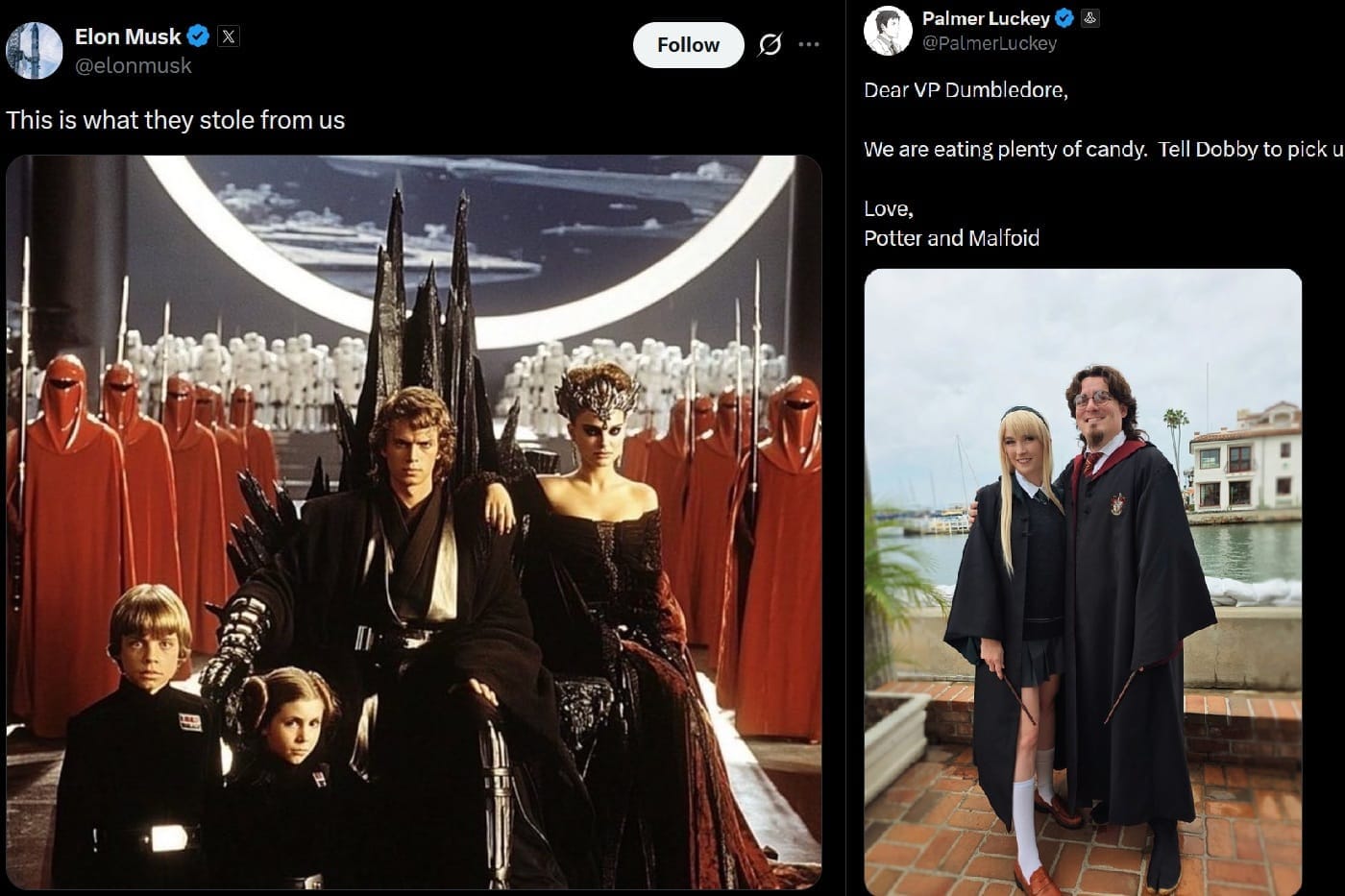
There's a BlazeTV YouTube video whose thumbnail shows the presenter with his arms around Anakin Skywalker and a gender-flipped Draco Malfoy called Malfoid. “Total Chud Victory?” It says. The video's title: “Young Right is Reclaiming Culture and Liberals Are Mad About it.”

BlazeTV posted the video on November 2, the day before Democrats swept the midterms and started a political realignment in America so overwhelming that Republicans lost control of all the most powerful state positions in Texas.

The video is a profound misreading of the political and cultural moment. It reminded me of stories of the Bolsheviks seizing the Winter Palace to discover tarot card playing courtiers who had no idea a revolution was happening in the streets.

The American version was watching defense contractor Palmer Lucky dress up like Harry Potter on Halloween while standing next to his Malfoid wife. And it was Elon Musk — who spent roughly half a billion on the election only to see his chosen candidates fail — posting an AI generated picture of Anakin Skywalker sitting at the head of a happy fascist Star Wars family two days before the midterms.

The online right has dominated American culture for a decade, or at least has dominated political narratives picked up by the mainstream media. Its memes and conspiracies drove news cycles. At first, the right’s memes filtered from random people on obscure Discord channels to Reddit’s r/the_donald or 4chan to Trump’s Twitter feed. More recently they’ve come from AI slop farms, from Musk, or from the administration itself. Powered by a well-funded media and podcast ecosystem, Fox News (and a propensity for shamelessness) its comedians, podcasters, and pundits became powerful celebrities and influencers, at least within Elon Musk’s X. 

This insular, often inscrutable world has given us Ben Shapiro, Nick Fuentes, Gamergate influencers, the streamer Asmongold, and a revolving door of characters who have shuffled interchangeably between Twitterverse celebritydom and actual government; Kash Patel, DataRepublican, Laura Loomer, Pete Hegseth, RFK Jr., Dan Bongino, the list goes on. 

It has been said many times that “Twitter is not real life,” and that posting too much anywhere will rot your brain. Never has that been more apparent than now: Much of Trumpworld spent the week before an election in which they would get utterly trounced using AI to generate barely legible Anakin and Malfoid memes for an inconsequential ingroup on the social media platform run by the biggest loser on the planet.

“It certainly seems like it has had its high water mark and that reality has FINALLY caught up with the Republican Party,” Michael Senters,  a research assistant at the Anti-Defamation League who studies online and gaming culture, told 404 Media.

In 2016, 4chan posters talked about  “meme magic” — the pseudo-ironic belief that pictures on the internet could manifest great change in reality. According to legend, Trump strategist Steve Bannon was running a World of Warcraft gold farm when he realized the angry gamers could be harnessed into a powerful reactionary political force. Bannon and others would successfully parlay Gamergate into an endless culture war that’s dominated online life in the Trump era.

During the midterm livestream of Bannon’s War Room podcast, his guest read exit polls that suggested the right-wing had lost young men — a group long thought to be its strongest soldiers. The split between the parties was even, the guest explained. “That can’t be right,” Bannon whispered, signalling he’d lost touch with the constituency he’d harnessed on behalf of Trump ten years ago. As the election results began coming in, right-wing podcasters, livestreamers, and newscasters across the internet went through at least a few of the stages of grief. First they struggled to understand what was happening, suggesting the votes must be wrong. Eventually, many of them ragequit. 

"Okay, I'm going to be honest. I'm absolutely rage quitting. I'm so frustrated. I am so unbelievably frustrated. I'm so mad. I think Trump didn't do 50 different things he should have done. I think he should have gone a thousand times harder. I think that he wasted his time selling trinkets and nonsense,” Asmongold said as the returns came in. He lives in Texas where Democrats swept in a shock victory.

“I wish that there were more people who thought like me that weren’t sorry about it. But you know what? There’s not. So it’s just me. And that’s fine. It’s fine. It’s OK,” he said, his voice catching in his throat.

Many right-wing personalities went into Tuesday somehow expecting to win despite a disastrous war, a disastrous economy, disastrous polls, and a doddering president whose closing argument seemed to be more about his ballrooms, golf courses, and the Reflecting Pool than anything else. Since Trump was re-elected, these same people have called everyone else out of touch, convinced by their X algorithm and prediction markets that no blue wave would materialize. The media has similarly spent many thousands of words suggesting that Bluesky is an out-of-touch leftist echo chamber while mostly failing to suggest anything of the sort about the AI-pilled Silicon Valley executives, bots, and racists shitposting on X. Tuesday’s election wipeout highlights how detached from reality the Malfoid/Anakin-shipping, X-brained billionaires and their acolytes have actually become.

“Blueskywave. Those of us on here, across the board, were out of touch. I see no other conclusion,” Joe Weisenthal of Bloomberg's Odd Lots podcast (who is a serious, good journalist), said in a post on X after the election amidst a sea of Anakins tonguing Malfoids.

The meme game and general demeanor of Trump and his followers has grown wildly tiresome in his thus far-disastrous second term. Under the guidance of White House Communications Director Steven Cheung, official government accounts have posted racist Halo memes, used AI to put a studio Ghibli face on anti-immigrant propaganda, and fully embraced Malfoid and Darth Vader as cultural heroes. The base on X loved this stuff. No one else did. 

As our friend Gita Jackson over at Aftermath wisely put it immediately before the election,”The idea that they can meme magic their way into a red sweep by posting about Anakin Skywalker a lot is pure desperation [...] Their values have been rejected by popular culture at large, and they are now resigned to exist in the margins.”

Senters said the midterms showed the hard limits of memes as a political tool. “The power that memes have has always been, in my opinion, the power to help define linguistic and community lines in the amorphous space of the Internet. You create a community when you ‘get the joke’ behind a meme but memes generally don't persuade,” he said. “I'll be curious to see if the government accounts will continue to post these far-right cultural memes in the wake of the defeat or if they'll change their tune at all. Like do they double down on the meme posting to try to rally their base? Because it very clearly had ZERO appeal to anyone outside their base.”

Yet the right-wing has spent the last ten years acting as if their memes had moved the country politically. “They deluded themselves into believing that memes carry persuasive power and that their bubble on X represented material reality in a meaningful way when that was no way close to the truth,” he said. “They saw how many ‘numbers’ the Malfoid and Anakin memes did on X and convinced themselves that this was a real cultural awakening moment and that the volk were on their side.”

Alyssa Mercante, an internet culture reporter who is writing a book about politics and video games called Rage Game, agreed. “I think what it's really showing is that when you start to get a little bit too deep in the weeds of this hyper online culture war stuff, it cannot escape the internet,” Mercante told 404 Media. “It is not working anymore. The material reality of America is just not good enough.” Gas prices are up. Everything is more expensive. And ICE has killed Americans in the streets. 

“This conspiratorial mindset is wrecker mentality. It is just destructive for the sake of destruction. There is no goal beyond pulling away any sort of legitimacy from the media or from democracy,” Mercante said. “When you get so deep in the weeds of this anti-establishment conspiratorial thought process, you just can't make anything or do anything of value. You're just upending tables and pointing at them and laughing.”

Democrats crushed Republicans who leaned into the online culture war during the midterms. Bo French — an overt racist who ran for railroad commissioner in Texas — sent text messages to voters that depicted himself as Master Chief from Halo. His opponent beat him by more than a million votes.

In Nevada, Halo composer Martin O’Donnell ran as a Republican for a House seat and lost to incumbent Susie Lee. O’Donnell announced his campaign on Discord and leaned hard into an extremely online gamer identity. “He’s like, ‘I wrote the Halo music and I’m voting for Trump and you should too.’ He did a Halo LAN party campaign fundraiser. The imagery was him as Master Chief,” Mercante said. “This dude is like: ‘My personality is gamers, gamers are not woke and they're resisting this [...] and Trump is the person that is going to help us resist,’ and he's polling like absolute dog water.”

It’s been 12 years since Gamergate set the tempo for online culture wars and a decade since Trump won in 2016. In 2026, Star Wars, Halo, Harry Potter feel dated in a way they didn’t back then. “What 22-year-old kid is going to be like ‘they took Halo from me.’ They don’t know Halo to have it taken away from them,” Mercante said. 

She stressed that so much right wing online culture is about distraction — she likened it to jingling keys to capture the attention of a baby. “If the economy is the number one issue for both Democrats and Republicans going into the midterms, no amount of Malfoid scissoring Anakin Skywalker is going to change that need for people to be in a better financial position,” Mercante said. “The tech oligarchs pushed this stuff straight into our eyes for two years straight unfettered [...] And I wake up and gas is this expensive? I don’t care if you take a Taylor Swift song and make JD Vance walk out to it.”

“[They] really thought that this would just last forever,” she added. “When you build up a meme presidency, eventually the cards just collapse underneath you, and there's just nothing to show for it.”

Though this midterm signals a move away from Gamergate-style culture war politics, both Senters and Mercante cautioned that this type of rhetoric is still dangerous, and can still be destructive. “They’re still very good at doing propaganda on the internet — they wrote the book in many cases,” Mercante said.

Read the whole story
InShaneee
2 hours ago
reply
Chicago, IL
Share this story
Delete

Study Claims Vizio Simply Ignores 'Smart' TV Spying Opt Out Requests

1 Share
An anonymous reader quotes a report from Techdirt: Recently, reports emerged that LG TVs are sniffing around your local network, and even listening to your local environment, even when the TV is purportedly "off." Some of those voice commands were then stored in plain text and uploaded to the internet. LG's response? To deny everything. [...] That latter point is central to a new study out of Northeastern that conducted 5,943 experiments across twelve commercial "smart" TV devices. The researchers found that most smart TVs utilize automatic content recognition (ACR), a technology that captures audio or video snapshots of viewed content and then monetizes that data to help build personalized profiles of viewers. TV makers insist that users are supposed to be able to opt out, but the choice simply doesn't work across a large segment of TVs. Companies like Vizio simply ignored the consumer requests entirely more often than not: "We find that the advertised ACR opt-out fully suppresses ACR-attributable traffic on only four operating systems; on Samsung Tizen traffic consistent with ACR activity persists in more than 60% of evaluated scenarios, and on Vizio SmartCast a content correlated endpoint hosted on Amazon Kinesis continues to receive traffic in 100% of opted-out scenarios." [...] The researchers say since they can't see the precise scope of what's being collected due to encryption, they're unsure whether Vizio is technically violating its FTC agreement (not that we have a current FTC that would care if they were): "The opt-out setting has no observable effect on traffic sent to this endpoint; however, we cannot inspect the payload due to encryption so we cannot confirm whether this violates the FTC settlement." Results of whether opting out of ACR tracking actually stopped ACR tracking were all over the map. Roku, for example, ignores opt-out requests when users are watching Roku's own channels. None of the smart TV vendors track Netflix viewing for fear of violating agreements with the streaming giant. Samsung's opt out function was more likely to actually work when a user was watching antenna broadcasts. On two Smart TV platforms, personal viewing data collected by ACR remains unencrypted, despite years of bad press and scandal on the subject. Many appear to be violating the law, but because U.S. regulatory oversight has been gutted, they see no meaningful accountability. That includes smart TV OS' like VIDAA, which is most prominently found on Hisense and Toshiba smart TVs: "VIDAA OS sends ACR data to servers run by Unruly over MQTT without encryption, so anyone on the network path between the TV and those servers can read it. Each message carries a Client ID, a permanent identifier for the TV that can't be reset, along with the time zone, the app name, the input (antenna, HDMI), the antenna channel and an audio fingerprint."

Read more of this story at Slashdot.

Read the whole story
InShaneee
2 days ago
reply
Chicago, IL
Share this story
Delete

Do you know signs of a stroke? BE FAST are the words to remember

1 Share
Sen. Chris Murphy, D-Conn., speaks to reporters in March 2026, in Washington. Murphy suffered a stroke on Saturday and is expected to recover.

Sen. Chris Murphy is expected to fully recover from his stroke. The acronym BE FAST can help you remember the symptoms of stroke and what to do when it happens: Call 911 quickly.

(Image credit: Allison Robbert)

Read the whole story
InShaneee
3 days ago
reply
Chicago, IL
Share this story
Delete

Meta Discussed 'Whisper Strategy' to Discredit Social Media Critic Jonathan Haidt, Files Show

1 Share
The Guardian reports: Meta staff discussed deploying a "whisper strategy" to undermine the influential US academic whose work has inspired a global social media crackdown, according to court documents. Employees at the parent group of Facebook and Instagram sought to discredit Jonathan Haidt, the social psychologist and author of The Anxious Generation, a book that helped tip the debate about online safety towards more stringent measures such as the under-16 ban in Australia. Minutes of internal meetings contained in a recent legal filing in the US showed that staff discussed how to "get the academic community to disavow Haidt". They appear in a document titled "Well-being Meeting Sound-check Notes", which refers to discussions of how Meta could "turn other academics against Haidt" and to a "whisper strategy" aimed at achieving that goal. It also mentions "debunking" his work. Minutes from a meeting on 8 March 2023 mention "Curtiss", an apparent reference to Meta's then vice-president of research, Curtiss Cobb. It states: "Curtiss's goal for this work: how do we get the academic community to disavow Haidt. Can't co-opt them, so how do we enrage them ... so the media finds him not credible." It then adds: "Not thinking about this as a loud strategy. A below-the-line campaign...." The minutes were produced before Haidt published his book in 2024 and discuss responding to a Substack post written by the academic in which he reviews "a bunch of articles". "It is not clear whether Meta acted on the ideas outlined in the minutes."

Read more of this story at Slashdot.

Read the whole story
InShaneee
3 days ago
reply
Chicago, IL
Share this story
Delete

Patrick Stewart has died at age 86

1 Share
A photo of Patrick Stewart

Patrick Stewart, best known for his roles in Star Trek and X-Men, has died at age 86. A message posted to Stewart's Instagram account says the actor died in his Los Angeles home on Wednesday "following a brief and poignant journey with Alzheimer's Disease and Lewy Body Dementia."

Born in 1940 in Mirfield, Yorkshire, England, Stewart began his acting career in theater. He eventually landed the role of Captain Jean-Luc Picard in Star Trek: The Next Generation, which ran from 1987 to 1994. Stewart returned as the Star Trek captain in subsequent films, including Star Trek: Generations (1994), Star Trek: First Contact (1996), Star Trek: Insurrec …

Read the full story at The Verge.

Read the whole story
InShaneee
6 days ago
reply
Chicago, IL
Share this story
Delete

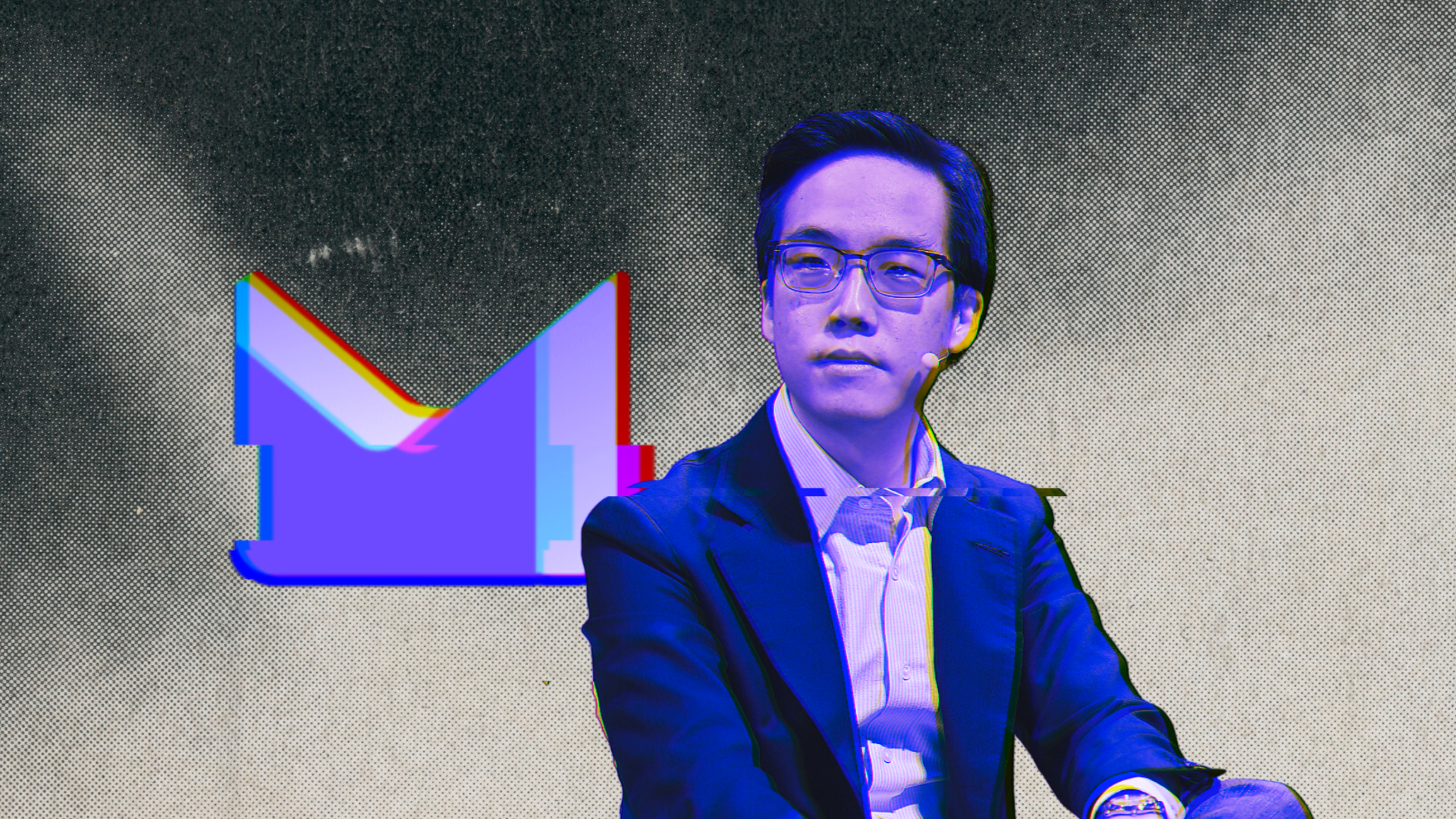
Manifestos, Fear, and ‘Loser Thinking’: Inside Proton’s AI Reckoning

1 Share
Manifestos, Fear, and ‘Loser Thinking’: Inside Proton’s AI Reckoning

Andy Yen, the CEO of Proton, had a message for an employee in the company’s security Slack channel who urged the company to at least take a few days to pentest newly written code before pushing it live. “That’s bullshit and loser thinking. Of course it’s possible to be fast and secure,” Yen wrote in the channel at the end of August. “Stop thinking always of how to be slower, and focus more on how to be faster.”

In a follow-up message, Yen reiterated his point: “only losers think like that.” His ultimate message for the team was to “stop lovingly handcrafting all our code and use AI more.”

That exchange was just one of many that showed how Yen and other company executives are aggressively pushing Proton towards AI. Proton is a Swiss company that famously makes the encrypted email service Proton Mail and a suite of privacy and security-focused products, including an encrypted drive service, an authenticator app, a password manager, and more.

In the last few months, Yen set up an email address for employees to contact if they come across anything blocking adoption of AI at Proton, so leadership can “ruthlessly smash everything that stands in the way of AI velocity;” Proton installed software on workers’ computers that track how much AI code the company is generating; and Yen said this is the last year that Proton will hire engineers at all, and instead only hire people to build things with AI.

That AI push came to head this week when 404 Media reported Proton said it would re-interview staff about their use of AI, with the clear implication that those interviews, and employees’ willingness to embrace AI, could decide whether a worker is fired or not.

404 Media spoke to eight current and one former Proton employees and reviewed Slack chats, meeting recordings, and an AI manifesto written by the company’s CTO. Our reporting reveals a culture of fear inside Proton, where many employees are hesitant to even mildly critique Yen’s views or discuss engineering problems. Workers describe an environment where employees have genuine concerns about security or being asked to develop security products with AI, but feel unable to voice them, lest Yen berates them in front of everyone or threatens their employment at the company.

“The CEO is in full AI psychosis and has been for a while now,” one of the sources told 404 Media.

Our reporting also paints a picture of Proton that is likely very different to the public’s perception of a company with a goal of carefully protecting privacy: one that in reality is barreling ahead with AI as quickly as possible so it can achieve the explicit goal of more annual revenue.

“Due to insufficient velocity,” Proton is not on track to achieve its annual recurring revenue target by the end of the year, one internal document obtained by 404 Media reads. Proton’s year-over-year growth is also “far away from what the market today considers to be good,” and, “By all metrics that matter, we’re an underperforming company.”

In response to detailed questions from 404 Media, a Proton spokesperson did not dispute any of our reporting or characterization of what’s happening inside of the company. 

“It’s clear that some people at Proton are unhappy with our direction, or misunderstand it, and many people are anxious,” they said. “In our determination to move fast, we have sometimes been too blunt or too slow in explaining ourselves to our people. We will work on that, as their questions are the ones we most need to answer.”

💡
Do you know anything else about Proton? I would love to hear from you. Using a non-work device, you can message me securely on Signal at joseph.404 or send me an email at joseph@404media.co.

Yen, a former CERN particle physicist, projects a measured approach in public, but internally he acts more like what one employee described as a “petulant child.” In May, Proton announced it was implementing post-quantum cryptography which should protect against future attacks from quantum computers. The work took years of effort, with one caveat that it would not work on older emails, only those written after the feature’s launch, at least for the moment. Yen was not happy that Proton was drawing attention to this limitation.

In a Slack channel dedicated to thanking people for their work, Yen jumped in. “Get it fixed,” he wrote, referring to Proton’s Reddit post announcing the feature. “Now Reddit is pissed and we look worse than Tuta,” he added, referring to a Proton competitor. When employees explained to Yen the nuances of the encryption and why that was not immediately possible, Yen wrote, “I find this whole thing stupid. You cannot announce this in this way.”

“Now we are left with two shitty choices. Deprioritize more important tasks for the business to re-encrypt old emails, or constantly get attacked online for not doing it. So maybe you can enlighten me on which of the two shitty choices we will take,” he wrote. “In the future there are two options. Either you guys are confident enough to not fuck this up, or you get my advice to make sure it is not fucked up,” he added. He then told a member of the team that made it to “go on Reddit.”

“So go on there with your personal account and comment to set the record straight,” he wrote. “Perception is more important than truth, the truth doesn’t matter if you don’t win on perception.”

One employee told 404 Media, “Whatever persona Andy [Yen] has out of Proton, he’s a straight up bully inside. He routinely breaks his little facade in Slack and calls people losers and stupid, often for stuff he’s paying them for.”

Ever since launching Proton Mail in 2014 after the Snowden revelations, Proton has steadily introduced new products that make Proton more of a worksuite than a simple email provider. More recently, those products were focused around AI, with the launch of Lumo, a large language model (LLM) chatbot that the company says doesn’t log conversations or train on user data. In June, Proton launched a 2.0 version of its chatbot.

Up until this point, Yen’s public comments on AI were relatively tame. In an August interview with WIRED, he said Proton is “building AI features and AI tools, because I think if the privacy companies do not find a way to step in to build privacy-first AI, we are essentially ceding the future to tech companies that don’t have the best interests of users at heart,” and that the company was “capitalizing” on the backlash to corporatized, invasive AI from companies like Google. Last year, Yen and Proton were criticized for statements he made suggesting the Republican Party and Donald Trump would be harder on Big Tech than Democrats. 

Toward the end of August, Yen’s internal tone on AI shifted to having Proton use it as much as possible, and as quickly as possible, according to the Slack chats and multiple employees.

“The train is coming, get onboard or get crushed. Don’t be the professional fax machine operator in the internet age,” he wrote to the security Slack channel. “I think by the end of this year most developers stop programming and start writing specs for tests that AI will code and run, to validate AI written code that humans will no longer be able to review. This will be the last year that we hire engineers, and starting next year we hire what we used to call product managers, to build things with AI.”

AI is changing how cybersecurity works, with AI agents hacking into companies, and AI assisting in the discovery of gaping vulnerabilities in important code. Many companies across the privacy and security space are grappling with how to deal with AI, either in the development of their products or how to defend themselves against hackers who are using AI. Some may do this carefully. Others are trying to do it as quickly as possible for profit. This account of Proton’s own reckoning with AI provides an unprecedented insight into what is happening inside one security-focused company users especially trust. 

Initially, using AI was banned inside Proton, but the company has since approved AI for all sorts of use cases internally, including processing financial data, drafting customer-facing responses on Reddit and LinkedIn, and writing code “except when that source code contains information that would give immediate advantage to a competitor” or is related to “innovation or R&D [research and development],” according to an internal Proton document seen by 404 Media. Ninety percent of code at Proton in October was written by AI, the company’s CTO Bart Butler said in a meeting, according to audio 404 Media obtained. Much of that code is written with Anthropic’s Claude, multiple employees told 404 Media. And Yen tells employees in Slack chats to use Claude, too. 

“We are a tech company against Big Tech who are spending loads on Claude,” one employee told 404 Media.

In the “bullshit and loser thinking” conversation, another employee pushed Yen for specifics on ensuring that AI-generated code was free of security issues. “AI won’t magically solve our problems, because security is low in our prioritization at present,” the engineer said. Yen didn’t respond directly, and went on to insult one of the other employees in front of the entire channel. The employee “is saying his usual bs of we can do it but we will be even slower than we are today and I’m saying only losers think like that,” Yen wrote, adding that workers should prompt “better.”

“You have the models and the time every developer should be doing this and checking their code which they were doing before manually but now they can do faster with AI,” Yen added. (One employee stressed that engineers still strive to build in a secure way.) 

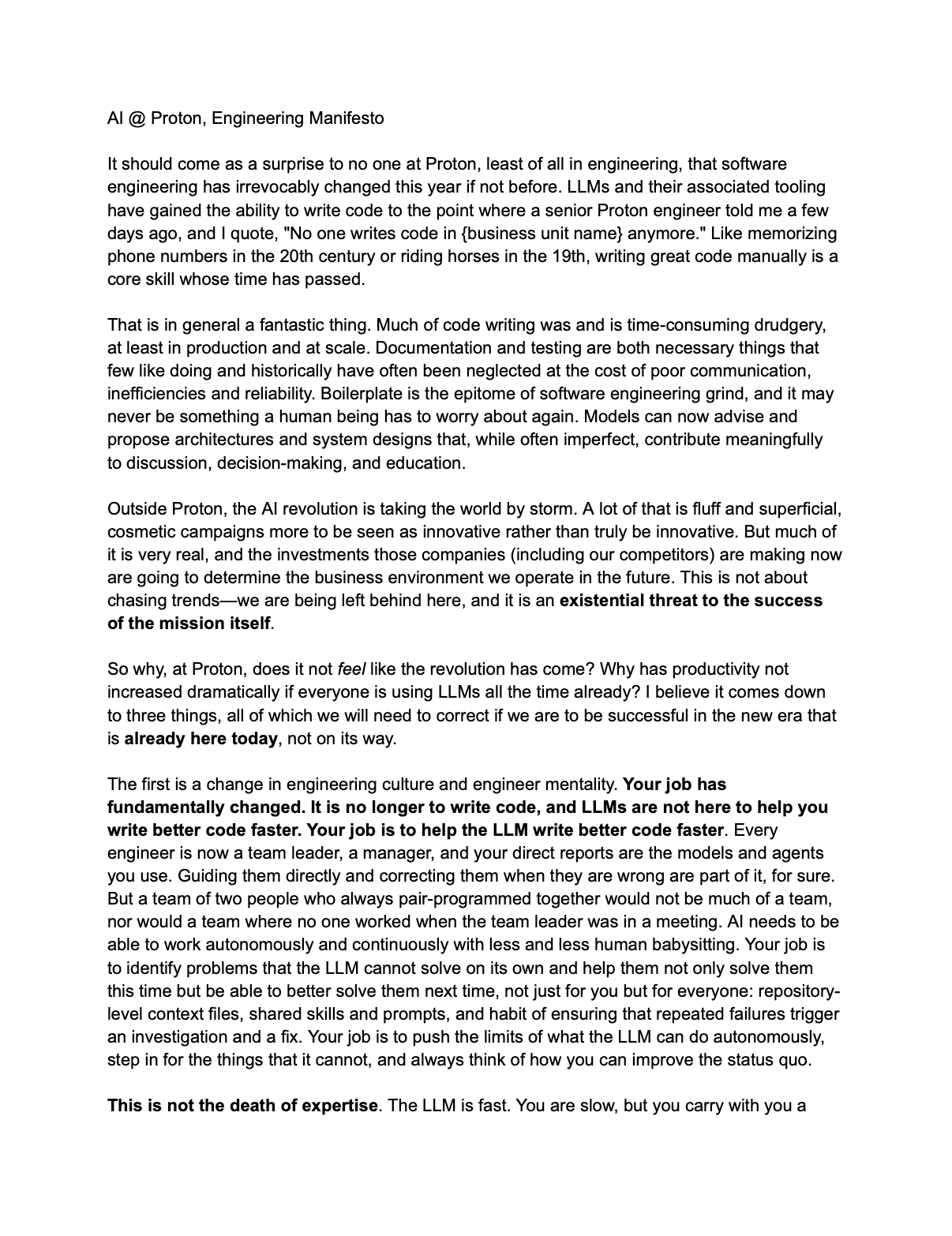
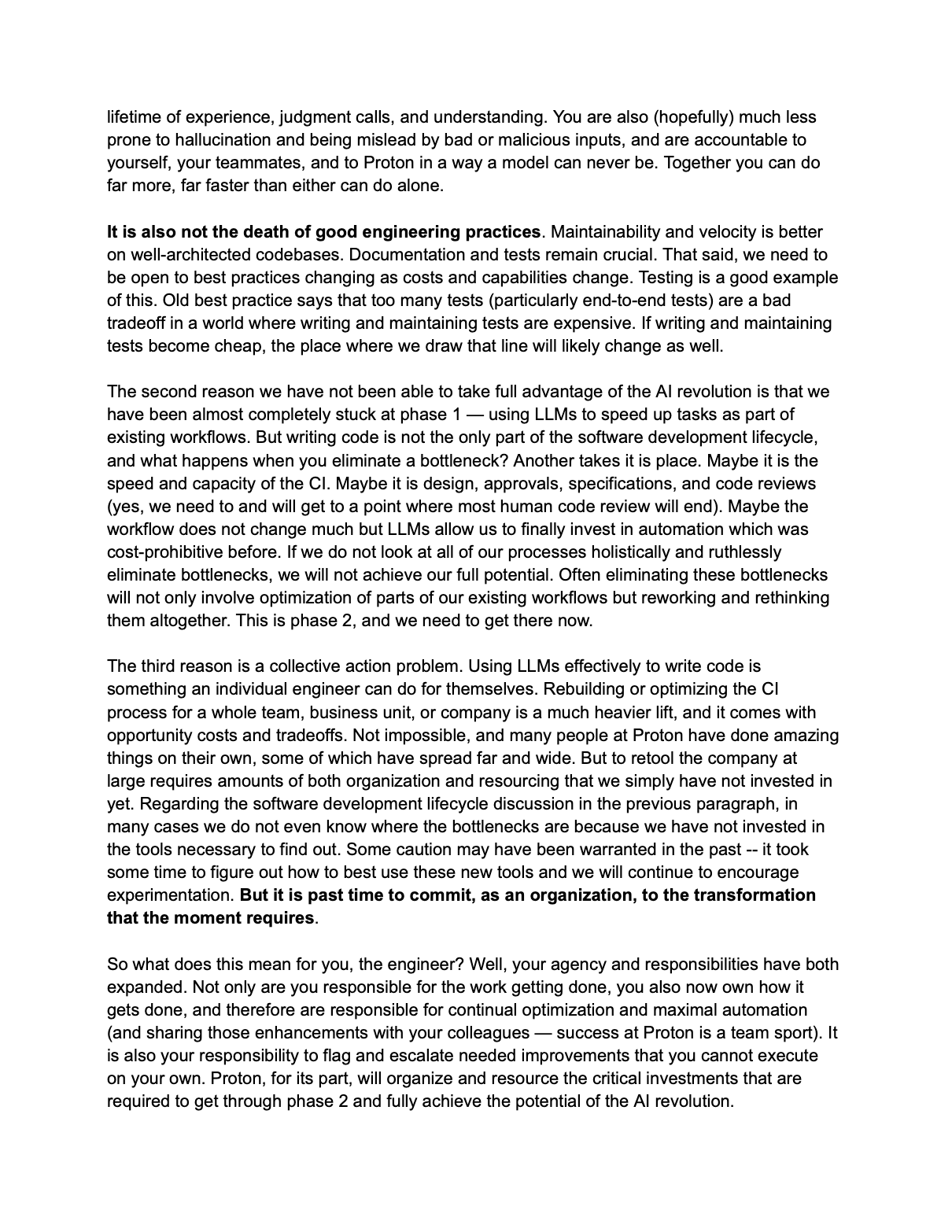
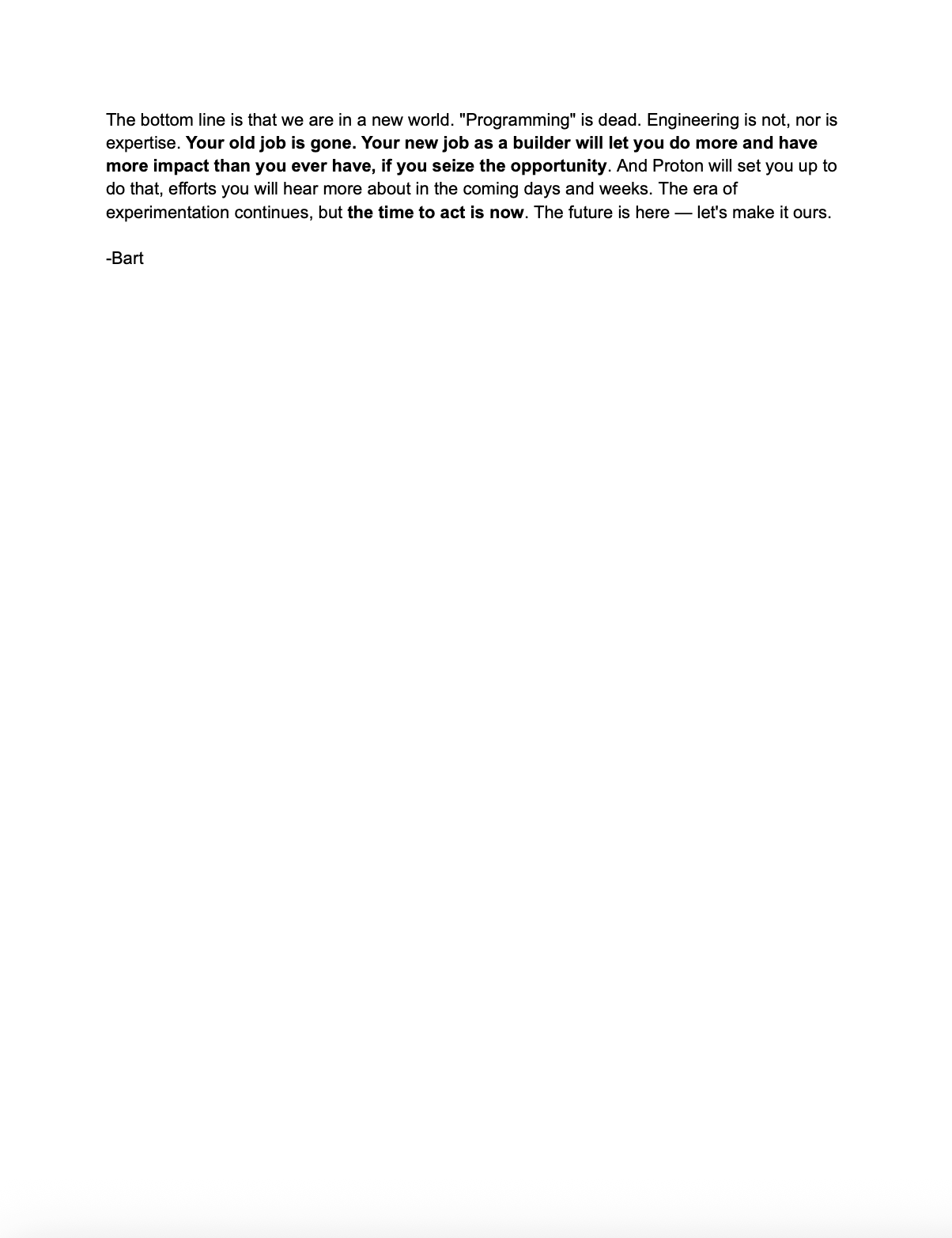
The second clear signal that Proton was going deep into AI for many employees happened when Butler, the CTO, published a self-described AI manifesto one Friday afternoon last month.

“Your old job is gone,” the manifesto, posted to Slack, told engineers. It laid out a future for Proton that fully embraced AI, and said if the company did not do so, that posed an “existential threat to the success of the mission itself.”

Butler said that Proton needs to change in three key ways: accept that an engineers’ job is now to help LLMs write better code, faster; that Proton needs to get to the point where most code is not reviewed by humans but by AI; and to more fundamentally change the company as a whole, and “commit, as an organization, to the transformation that the moment requires.”

One Proton employee replied in Slack, “Perhaps scaring people with: We are in a new world. ‘Programming’ is dead [...] your old job is gone wasn’t really necessary on a Friday afternoon.”

Butler replied, “It’s supposed to be provocative, because it needs to be. I suggest you read it, think about it over the weekend, and come with your questions to me on Monday rather than on Slack. Thanks!”

An employee told 404 Media, “​​People were surprised and somewhat cringed out, since the document clearly exaggerates what you can do with LLMs today and doesn't address any of the problems you get in return for giving up your code base to the AI Jesus (e.g. AI cannot really maintain a large code base over time).” Another called it “ethically bankrupt.”

Earlier this week, Proton sent the email to employees saying they would re-interview workers about how they use AI in their jobs. The tone was clear; you may lose your job because of these interviews, current employees told 404 Media. “These re-interviews are consequential,” the email read. Soon after, a senior employee spoke up in Slack to Yen about the re-interviewing process. He suggested instead that Proton detect who is falling behind and support them and enforce high quality training.

Yen’s response was blunt: “Let’s put it this way, we already know more or less who is behind. If we were giving up on them, we would not bother with this process.”

The employee replied, “That messaging is fear-based. Which is probably why I suspect there are dozens of other employees watching us talk about this live and except for [other employee] no one else is chiming in.”

“People shouldn’t be scared to talk about this in public and to push back on you and leadership. A fear based culture feels like a cancer to me. It’s the opposite of engineering, you need to talk about things, even uncomfortable things,” they added. Yen eventually told the employee, in front of everyone: “If you are making the accusation that this is a financially driven decision and you don’t trust me when I tell you it’s not, then I think this might not be the place for you.”

Manifestos, Fear, and ‘Loser Thinking’: Inside Proton’s AI Reckoning
Image: Sipa USA via AP.

Only one other employee chimed in during that exchange: “It’s about the culture you instil, people don’t want to feel like they’re on a tightrope, and yes we understand you want to move fast but there needs to be a balance, people also need support, not everyone is the same.”

“It was also faster for my parents to beat me until I ate my vegetables but I’m not sure it was healthy,” they added.

The exchange with Yen was unusual not only in that someone was debating some of Yen’s ideas, but also that it directly referenced the culture of fear at Proton. “Whenever someone talks back to Andy it tends to be highlighted since very few people talk back to him,” one employee told 404 Media.

Proton sources described that culture in various ways to 404 Media. One said, “People just shut up and get on with things.” Another added, “Most have just given up. Your expertise will be undermined, you will be told to do what the CEO wants, and there’s a decent chance you’ll be called all types of stupid in the process.” A third said there is “100%” a culture of fear, especially in the last few months. “Andy [Yen] tends to not communicate; when things are communicated, it is ‘this is happening.’ Views in which he doesn’t share, he can be hostile to and will shit on people in public chats. Like even for managers… which doesn’t look very prof[essional].” A fourth said, “Andy [Yen] truly seems to hate a lot of the people that work here.”

In a meeting held after leadership sent the re-interview email, which 404 Media obtained audio of, Butler said that not everyone who received the email would in fact be re-interviewed. “So don’t freak out if you don’t receive an invite. Most of you will, but not all, just for logistical reasons and otherwise, or it’ll happen later.”

“Nobody gets a pass from this, basically,” he said, referring to how Yen had already interviewed around 40 people, including Butler. Yen also re-interviewed Eamonn Maguire, the director of engineering for AI and machine learning, he said at another point. People who scored highly in those interviews are now being tasked with interviewing other Proton employees, Butler said.

“You should not blow this off, okay? It's consequential. It's not either that you are interviewing, fighting for your life, like in some sort of Hunger Games thing,” he continued. But, “it’s an opportunity and a risk, okay? If you haven’t done anything with AI and you haven’t thought about it, you haven’t changed how you work, and you’re in product design or engineering, well, now is the time. And if you have done things and you feel confident in it, that’s good too.” A speaker in the meeting also mentioned that some people may get promoted through the re-interviews.

“I think we’ll see what the results say. But I urge you to take it seriously, but not freak out, I guess,” Butler said. “This isn’t a witch hunt,” he added. “It’s not a religion.”

As for why this push for AI is happening around, “It’s because we ran out of time,” Butler said.

“Perception is more important than truth, the truth doesn’t matter if you don’t win on perception.”

Yen’s feverish desire for Proton to radically embrace AI can be explained, at least in part, by an internal Proton document laying out the company’s intention to make something it is calling a fast team of people who will try to make the company build at a much more rapid clip. The document says Proton is not on track to achieve its annual recurring revenue target by the end of the year because of “insufficient velocity.”  The company’s year-over-year growth is “far away from what the market today considers to be good,” and, “By all metrics that matter, we’re an underperforming company.”

Second, the document says Proton transitioning to an “AI-first company” requires additional time and effort before it will start to see efficiency gains. For around six months, Proton has been in an experimental phase with AI, but now the company is taking concrete steps to restructure the company around AI, according to meeting audio 404 Media obtained.

Third, the document says Proton “suffered a catastrophic 6 hour downtime which showcased to the world (and to us) that Proton’s engineering is not actually reliable and resilient. We need to quickly remedy this problem, which will also increase workload because we need to pursue these reliability improvements simultaneously with shipping features ASAP to accelerate our growth rate.” That incident was in August.

Possible solutions to make the company faster are to move to the U.S. or China, the document says, which is “not an option for Proton unfortunately,” presumably referring to being headquartered in Switzerland for its strong privacy protections. Second is firing a lot of people and then rehiring, which Proton says is unrealistic because “we are based in Europe, where firing the wrong people is slow, and hiring the right people even slower.” The third is to “transform the company from within.”

To solve some of these apparent problems, the document calls for the creation of an “elite fast team” which will demand a lot more work, including weekends. Being on the fast team offers a 30 percent increase to base salary, paid out as a monthly bonus; a company credit card employees can use to order food if working hard during weekends, upgrade a long haul flight work flight to business class, get a five star hotel when visiting another office, or take colleagues out to dinner for team building. 

“This program is not for everybody. It requires a certain drive and mental toughness. We expect it to be no more than 5-10% of the company. But for the ambitious, the young (or old), or those who are simply bored, come join the team that will re-found Proton for the future,” the document says. Yen also spoke in Slack chats about Proton being a “996 company,” referring to the culture of working from 9 a.m. to 9 p.m., six days a week, a practice that started in China and is becoming popular in Silicon Valley. The extra perks and money appear to be a move to get employees to work more than their contracted hours, which is harder to implement in Europe given its strong labor laws. 

“That’s bullshit and loser thinking. Of course it’s possible to be fast and secure.”

In other settings where Yen is not present, employees and managers are more open about what is going on. 

In another meeting 404 Media obtained audio of, a Proton employee said they do not trust Andy’s judgement on highly technical choices. In another, even Butler said Yen doesn’t understand the technical points about the AI topics he is re-interviewing people on.

“And for those of you maybe, oh, what the fuck does Andy know about anything technical? He doesn’t, and it’s not that technical,” Butler said. “But what this approach does do, is there’s nothing like a deadline to motivate people,” he said, referring to the re-interviews.

When asked about Yen’s comments, whether there is a culture of fear in Proton, and may people be fired based on the re-interviews, a Proton spokesperson told 404 Media in an email, “Times of major change are scary, and the tech industry as a whole is contending with this transition. We have not always communicated our intentions as well as we could have, but Proton is committed to helping our colleagues retrain and reskill for the future.” 

On Wednesday, Yen started a new thread in the company’s Slack in an uncharacteristically calmer tone. “When thinking about Al, it's not really about the capabilities today, but what capabilities might be possible in the future, which is probably less distant than we think. We will need to transform our org, and doing so requires knowing who is using Al well, who is mis-using Al, or who hasn't used Al at all (don't be in this group),” he wrote. For much of the day, with the November re-interviews looming, almost nobody was working on actual work and standup meetings were cancelled, one employee said.

One employee replied to Yen with Reddit posts from Proton users reacting to 404 Media’s article first breaking news of the re-interviews. “I'm paying a premium for this service and as such I demand that corners are not cut simply because some new technology of dubious means comes into existence. I want coders to understand their code. I want them to think about the problems they are trying to solve and come to those conclusions naturally. It will create a better product with reproducible results. If you want to replace some jobs replace the jobs of the people who thought this email was a good idea,” one of them pasted into Slack read.

Yen, usually concerned with what people were saying on Reddit, didn’t respond.

Read the whole story
InShaneee
7 days ago
reply
Chicago, IL
Share this story
Delete
Next Page of Stories