The once defiant makers of Grammarly, Superhuman were forced to eat a little AI crow today. After enlisting countless authors, writers, and journalists for its much-needed “Expert Review” feature, the company has reversed course because it did so entirely without their consent, prompting a class action lawsuit. “Expert Mode” allowed Grammarly subscribers to receive phony analysis made by an LLM that’s been trained on the work of famous writers, living or dead, in an effort to “take your writing to the next level.” Of course, seeing as this is a tech company we’re talking about, and everything is just data for them to train their products on, Superhuman did so without the consent of its “leading professionals, authors, and subject-matter experts.”
Earlier today, Wired reported that Markup founder Julia Angwin is the only named plaintiff in a class action suit against Superhuman, arguing damages exceeding $5 million. “We think it’s a pretty straightforward case,” Angwin’s attorney told Wired. He goes on to argue that this type of behavior from tech companies is happening across society. “Lots of professionals who spend years, or in Julia’s case, decades, honing a skill or a trade, then see that their name or their skills are being appropriated by others without their consent.”
The feature received widespread condemnation from the authors who were non-consentually recruited for the program, including tech journalist Kara Swisher, AI blogger Casey Newton, and the staff of The Verge. The latter reached out to Grammarly, which informed them earlier this week that victims of identity theft could “opt out” of the program they never signed up for.
But apologies are a feature of the AI hype machine, not a bug, and so the CEO of Superhuman, Shishir Mehrotra performed the modern Notes app apology: An extended mealy-mouthed LinkedIn post. “Over the past week, we received valid critical feedback from experts who are concerned that the agent misrepresented their voices,” he wrote. “This kind of scrutiny improves our products, and we take it seriously. As context, the agent was designed to help users discover influential perspectives and scholarship relevant to their work, while also providing meaningful ways for experts to build deeper relationships with their fans. We hear the feedback and recognize we fell short on this. I want to apologize and acknowledge that we’ll rethink our approach going forward.”
So what did we learn here? For one thing, a future in which AI is firmly foisted upon users isn’t one that users have to stand for. Complaining about these products widely and loudly can help prevent the slop trough from filling too quickly. Additionally, we learned that a class action suit couldn’t hurt.
When David saw his friend Michael’s social media post asking for a second opinion on a programming project, he offered to take a look.
“He sent me some of the code, and none of it made sense, none of it ran correctly. Or if it did run, it didn't do anything,” David told me. David and his friend’s names have been changed in this story to protect their privacy. “So I'm like, ‘What is this? Can you give me more context about this?’ And Michael’s like, ‘Oh, yeah, I've been messing around with ChatGPT a lot.’”
Michael then sent David thousands of pages of ChatGPT conversations, much of it lines of code that didn’t work. Interspersed in the ChatGPT code were musings about spirituality and quantum physics, tetrahedral structures, base particles, and multi-dimensional interactions. “It's very like, woo woo,” David told me. “And we ended up having this interesting conversation about, how do you know that ChatGPT isn't lying?”
As their conversation turned from broken code to physics concepts and quantum entanglement, David realized something was very wrong. Talking to his friend — whom he’d shared many deep conversations with over the years, unpacking matters of religion and theories about the world and how people perceive it — suddenly felt like talking to a cultist. Michael thought he, through ChatGPT, discovered a critical flaw in humanity’s understanding of physics.
“ChatGPT had convinced him that all of this was so obviously true,” David said. “The way he spoke about it was as if it were obvious. Genuinely, I felt like I was talking to a cult member.”
💡
Do you have experience with AI psychosis? I would love to hear from you. Using a non-work device, you can message me securely on Signal at sam.404. Otherwise, send me an email at sam@404media.co.
But at the time, David didn’t have a way to name, or even describe, what his friend was experiencing. Once he started hearing the phrase “AI psychosis” to describe other peoples’ problematic relationships with chatbots, he wondered if that’s what was happening to Michael. His friend was clearly grappling with some kind of delusion related to what the chatbot was telling him. But there’s no handbook or program for how to talk to a friend or family member in that situation. Having encountered these kinds of conversations myself and feeling similarly uncertain, I talked to mental health experts about how to talk to someone who appears to be embracing delusional ideas after spending too much time with a chatbot.
Most Americans disapprove of President Trump's handling of Iran, and a majority sees Iran as either only a minor threat or no threat at all, an NPR/PBS News/Marist poll finds.
Customs and Border Protection (CBP) bought data from the online advertising ecosystem to track peoples’ precise movements over time, in a process that often involves siphoning data from ordinary apps like video games, dating services, and fitness trackers, according to an internal Department of Homeland Security (DHS) document obtained by 404 Media.
The document shows in stark terms the power, and potential risk, of online advertising data and how it can be leveraged by government agencies for surveillance purposes. The news comes after Immigration and Customs Enforcement (ICE) purchased similar tools that can monitor the movements of phones in entire neighbourhoods. ICE also recently said in public procurement documents it was interested in sourcing more “Ad Tech” data for its investigations. Following 404 Media’s revelation of that ICE purchase, on Tuesday a group of around 70 lawmakers urged the DHS oversight body to conduct a new investigation into ICE’s location data buying.
This sort of information is a “goldmine for tracking where every person is and what they read, watch, and listen to,” Johnny Ryan, director of the Irish Council for Civil Liberties (ICCL) Enforce, which has closely followed the sale of advertising data, told 404 Media in an email.
💡
Do you work at CBP, ICE, or a location data company? I would love to hear from you. Using a non-work device, you can message me securely on Signal at joseph.404 or send me an email at joseph@404media.co.
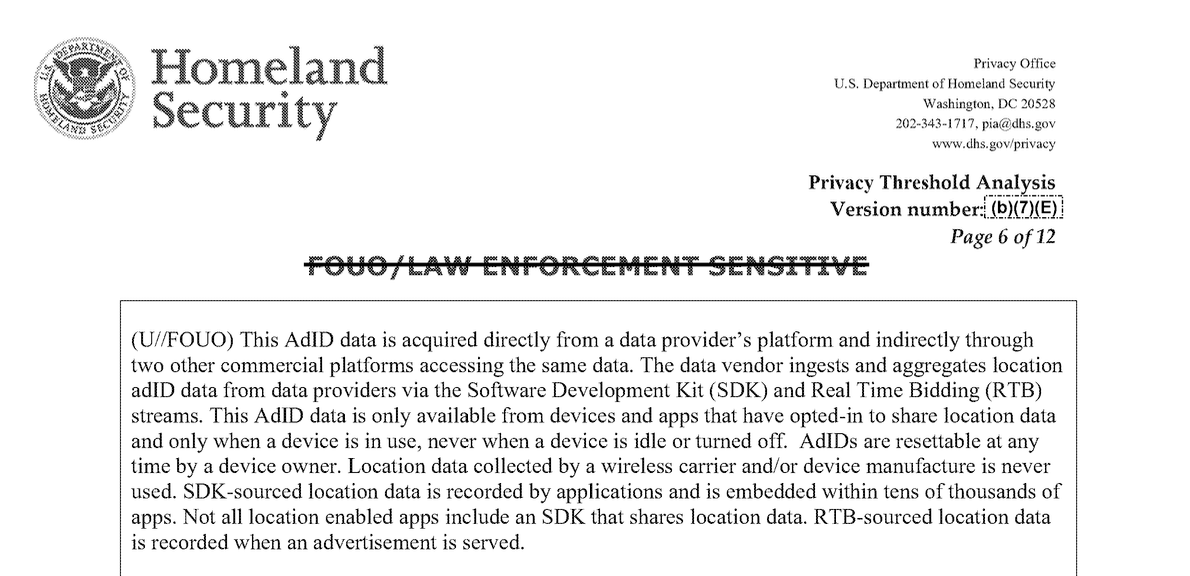
The document 404 Media obtained is the first time CBP has acknowledged the location data it bought came from the advertising industry. Specifically, CBP says the data was in part sourced via real-time bidding, or RTB. Whenever an advertisement is displayed inside an app, a near instantaneous bidding process happens with companies vying to have their advert served to a certain demographic. A side effect of this is that surveillance firms, or rogue advertising companies working on their behalf, can observe this process and siphon information about mobile phones, including their location. All of this is essentially invisible to an ordinary phone user, but happens constantly.
This sort of surveillance can happen through all sorts of innocuous seeming apps, such as video games, news apps, weather trackers, and dating apps. 404 Media has previously linked RTB-based surveillance to games like Candy Crush and Subway Surfers; dating apps Tinder and Grindr; the social network Tumblr, and the popular fitness app MyFitnessPal. In many cases, the app developers themselves are likely unaware they are acting as a conduit for government surveillance because the data collection is not based on any code the app creators have included themselves. The end result is tools that can potentially track hundreds of millions of phones, often without a warrant.
“RTB-sourced location data is recorded when an advertisement is served,” the DHS document reads. The document is a Privacy Threshold Analysis (PTA), a type of record DHS is required to complete when deploying or exploring a new technology. 404 Media obtained it through a Freedom of Information Act (FOIA) request.
A section of the document. Image: 404 Media.
The document lays out how the online advertising industry gave birth to this sort of surveillance. Traditionally, marketers used cookies to track consumers’ activities. When those grew less effective due to the rise of smartphones and apps in the 2010s, Apple and Google created Advertising IDs, or AdIDs, that are assigned to each device. These are unique identifiers that, although they don’t contain a person’s phone number or name, still provide a way for the online advertising industry to track devices. As the document says, “this allows app developers to still track and report a device’s consumer activity, to include date/time and locational information, without connecting to or using any personally identifiable information (PII) associated with the device.”
In essence, the AdID acts as the digital glue between a person’s device and their location data, allowing marketers—or a surveillance contractor or DHS—to attribute a set of movements to a specific device. From there, investigators can draw geofences to see all phones at a particular area over a period of time. Many smartphone location data tools then let officials see where else those devices went, potentially revealing where their owners live or work, or other sensitive locations.
“It operates behind the scenes on websites and apps, and it puts everyone at risk. RTB is the world’s biggest data breach,” Ryan added.
CBP acknowledged a request for comment, which asked whether CBP is still using this sort of data, but ultimately did not comment.
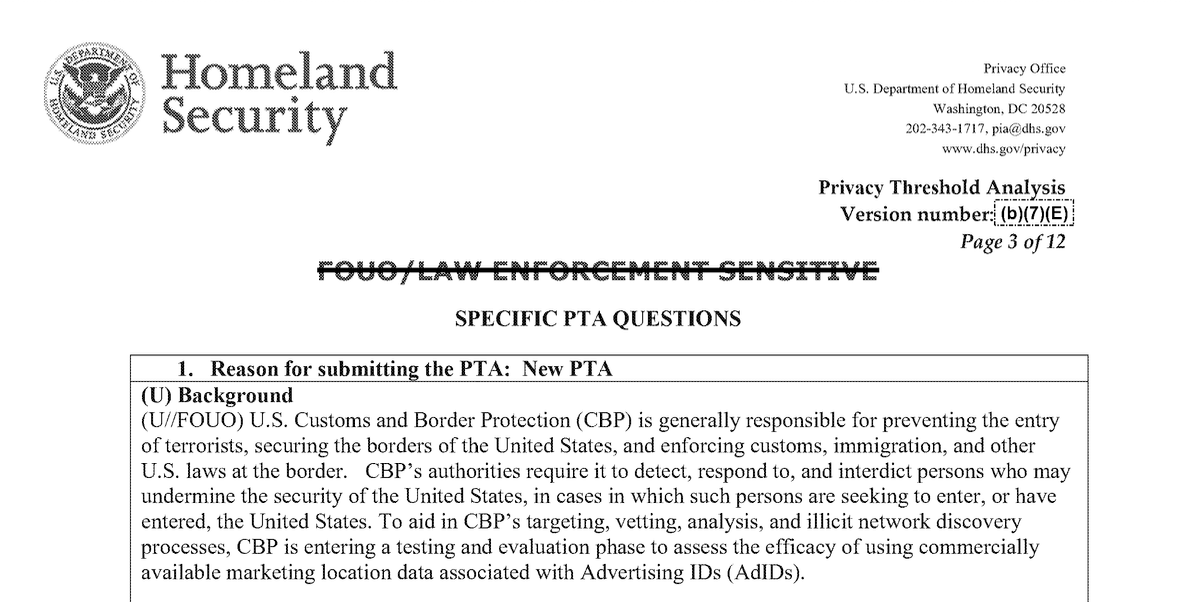
A section of the document. Image: 404 Media.
The internal document relates to a “pilot” program CBP previously ran from 2019 to 2021, which would “aid in CBP’s targeting, vetting, analysis, and illicit network discovery processes,” it says. The document says the “evaluation will be focused on AdIDs associated with cross border criminal activity and/or activity with an identified terrorist/criminal predicate.”
Although CBP described the move as a pilot, the DHS Office of the Inspector General (OIG) later found both CBP and ICE did not limit themselves to non-operational use. The OIG found that CBP, ICE, and the Secret Service all illegally used the smartphone location data, and found a CBP official used the data to track coworkers with no investigative purpose. CBP and ICE went on to repeatedly purchase access to location data.
In 2020 The Wall Street Journal was first to report on CBP and ICE’s purchase of commercial location data from a vendor called Venntel. The report said ICE used the data to help identify immigrants who were later arrested, and CBP used the data to look for cellphone activity in unusual places, including the stretches of desert on the Mexican border. The FTC later found Venntel illegally sold location data collected without proper consent.
In January, 404 Media reported on material which explained how a similar and more recently ICE-purchased system called Webloc works. It is designed to monitor a city neighborhood or block for mobile phones, then let ICE track the movements of those devices back to their likely homes or other locations. The material did not say how Penlink, the company selling the tool, obtains this location data. But surveillance companies broadly either obtain it through RTB, or small bundles of code called software development kits (SDKs) inserted into ordinary apps.
“By refusing to cut off surveillance companies and sleazy data brokers, Big Tech companies are effectively collaborating with ICE’s lawless campaign of violence and terror. As a result, every internet ad on a website or app could be collecting location data that ICE will use for its next operation,” Senator Ron Wyden told 404 Media in a statement.
“Congress could put a stop to this by passing my bills to ban the government from buying our data and ban tech companies from using surveillance advertising. Until then, the best way for the public to protect themselves is to install ad blockers, disable their phone's advertising ID, and enable the Global Privacy Control in their browser, which 12 states now enforce,” the statement added.
On Tuesday, Wyden, Rep. Adriano Espaillat, and a group of 70 other lawmakers sent a letter to the DHS OIG urging it to once again investigate DHS’s purchase of location data.
“Public reports indicate that ICE has resumed its location data purchases, even though DHS has yet to adopt all of the recommendations from your prior review,” the letter, shared with 404 Media by Wyden’s office, reads. “Your 2023 report noted that there was no DHS-wide policy governing component use of commercial location data. DHS created a commercial data working group in 2022, but as of April 2023, the DHS commercial data working group had yet to issue a policy. Your office recently confirmed that this recommendation remains open.”
The letter says that ICE is “stonewalling” Wyden’s efforts to investigate the Webloc purchase. Wyden’s office requested a briefing on the purchase after 404 Media first revealed it, with that briefing scheduled for February 10. “One day before that briefing was to take place, ICE cancelled it with no explanation and without any offer to reschedule,” the letter reads.
In January ICE posted a request for information—essentially a callout for capable companies to come forward—looking for more access to advertising technology. ICE “is gathering information to better understand how the industry’s commercial Big Data and Ad Tech providers can directly support investigations activities,” the announcement reads. “The Government is seeking to understand the current state of Ad Tech compliant and location data services available to federal investigative and operational entities, considering regulatory constraints and privacy expectations of support investigations activities,” it added.
An anonymous reader quotes a report from Ars Technica: Charter Communications, operator of the Spectrum cable brand, has obtained Federal Communications Commission permission to buy Cox and surpass Comcast as the country's largest home Internet service provider. Charter has 29.7 million residential and business Internet customers compared to Comcast's 31.26 million. Buying Cox will give Charter another 5.9 million Internet customers. The FCC approved the deal on Friday, but the companies still need Justice Department approval and sign-offs from states including California and New York.
Opponents of Charter's $34.5 billion acquisition told the FCC that eliminating Cox as an independent entity will make it easier for Charter and Comcast to raise prices. But the FCC dismissed those concerns on the grounds that Charter and Cox don't compete directly against each other in the vast majority of their territories.
FCC Chairman Brendan Carr's primary demand from companies seeking to merge has been to eliminate diversity, equity, and inclusion (DEI) programs and policies. In a press release (PDF), the Carr-led FCC said that "Charter has committed to new safeguards to protect against DEI discrimination," and that Charter's network-expansion plans will bring "faster broadband and lower prices" to rural areas. The merger was approved one day after Charter sent a letter to Carr outlining its actions to end DEI. Charter offers broadband and cable service in 41 states, while Cox does so in 18 states.
When the modern electric vehicle was still in its infancy, drivers worried that vehicles would need expensive battery replacements within a few years. But battery lifespans are exceeding expectations.
 Log in