🎉
YOU'RE INVITED! 404 Media is turning three, and we're throwing TWO separate events in NYC to celebrate:
A live taping of the podcast with a special night of talks on Sept. 3, and
an open-bar bash on Sept. 4.
Subscribers at the Supporter level get free and discounted access to both events. Not a 404 Media Supporter yet?
Sign up, and get all the party
details here.
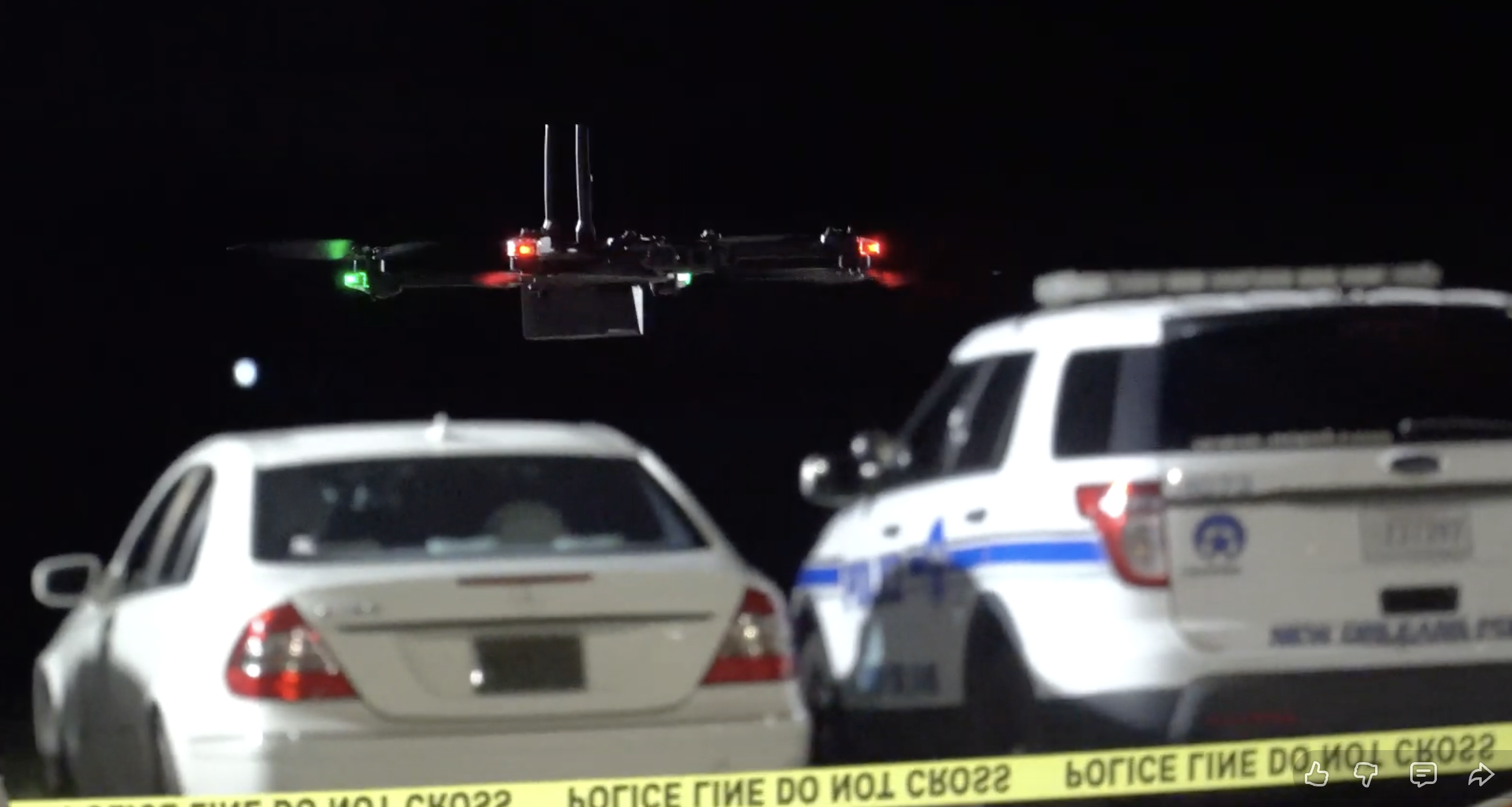
The New Orleans Police Department (NOPD) looked at ways to arm quadcopter drones with weapons, according to a draft version of its drone manual shared with 404 Media. A draft version of the manual, which was live on the NOPD website in June, said that the department’s drones could only be equipped with weapons with written approval from the Superintendent of Police.
The current version, live as of July 1, has different language: “The sUAS shall not be equipped with weapons or hazardous materials of any kind,” referring to small Unmanned Aerial Systems, or drones. According to the NOPD, the operations manual it published to the internet with the rules for weaponized drones was an early draft.
“The manual published on July 1 is the current published version of the policy. Earlier versions were draft versions that were presented for review before adoption of the current policy,” NOPD told 404 media. “NOPD has made it clear we are not and will not be equipping drones with weapons or other hazardous materials.” NOPD didn’t answer follow-up questions about how or why the draft version of the manual was published.
But the publication of a police drone manual that opens the door for weaponized quadcopters is important, and comes as drone companies and police flirt with the idea of putting weapons on their drones. New Orleans has long been a pioneer of camera and drone driven policing and the cops have used controversial tactics to get around public scrutiny and regulations. It shows that what the police are circulating amongst themselves and thinking about privately, what they perhaps want to happen, does not match public policy.
NOPD has a history of finding creative ways to work around public policy and scrutiny when it comes to surveillance tech. A private company called Project New Orleans operates a network of cameras that provide live facial recognition to the city’s cops. The company operated in secret cooperation with NOPD for two years before the Washington Post exposed it in 2025. According to the ACLU, NOPD has continued to use Project New Orleans in contravention of local laws and has stonewalled public records requests.
Federal Aviation Authority regulations prohibit the operation of drones equipped with a “dangerous weapon.” Matthew Guariglia, a senior policy analyst at the Electronic Frontier Foundation, told 404 Media that he didn’t see how the police arming drones could possibly be legal. But the FAA regulation was written in 2018 and things have changed a lot in just the last few years. Last month, Guariglia argued that “we have precious little time” to stop police from arming their drones, and that the industry was moving that way.
One of the companies selling NOPD its drones is Skydio. The US-based manufacturer of quadcopter drones has done very well since the Trump administration banned the sale of foreign-made drones last year. Skydio has always marketed itself as a drone company for first responders and had a cozy relationship with police departments around the country.
In 2020, Skydio wrote “we will not put weapons on our drones and will oppose fully autonomous lethal weapons systems.”
But Skydio CEO Adam Bry walked this back in a June 15 interview on Decoder. “So this is an area where I think I’ve gotten some things wrong. We’ve said some things previously that led some folks externally and internally to believe that, for example, we would prevent the military from putting weapons on our drones,” Bry said.
“It’s not our place to tell them what they can and can’t do,” he said. “It should be up to the folks who’re putting their lives on the line to decide how to use it.”
He added that terrorists don’t follow terms of service. “They don’t care what our policy says,” he said. “I think when you start trying to draw these bright lines and say: this is good, this is bad, more often than not you’re going to end up on the wrong side of moral questions.”
Guariglia also pointed to a planned pilot project in Georgia that will test “less lethal” armed drones to nominally stop school shootings. He noted that in recent years many drone regulations have been ignored or relaxed.
“You used to have to have line of sight of your drones and now law enforcement [...] are phasing that out or offering exemptions,” Guariglia said. “If you want to police divisions a few years ago, they were selling drones capable of flying miles and miles in a couple of minutes and you’d ask them about the line of sight rule and they would just shrug. They are preparing for the day when law enforcement gets whatever they want.”
“Clearly they’re thinking about it,” Guariglia said of the NOPD manual that included a provision for armed drones. “Drones have always been a bit of a solution in need of a problem. There are few things that police say they need drones for that they cannot get by other means, and I think by putting other tools on them, they are still on a quest to figure out what drones are really good for.”
Arming drones could lower the bar for police to use force. “We have seen how consequence-free it can be for officers to deploy force at somebody who’s standing in front of them when they have to confront the fact that it’s a fellow human and they still have to draw their night stick or their Taser or their gun,” Guariglia said. “That would become so much easier and so much less emotionally and physically burdensome if they can deploy force by pressing a button.”
All this tech costs a lot of money. “Cities are spending an astronomical amount on drones and for maintenance of the drones. They're hiring all these drone pilots. They have to have special infrastructure to fly all these drones, and companies are getting rich. But really, there is no problem in policing that drones have straight up solved yet,” Guariglia said.
On June 24, the New Orleans city council approved a $250,000 budget request to expand Skydio’s reach in the French Quarter. The funds will purchase a massive docking station and support a “drones as first responders” (DFR) program, meaning that people who call 911 in the French Quarter may see a quadcopter drone before they see a police officer. NOPD told the city council that these drones won’t run facial recognition software and will not be armed.
The existence of the draft that was “presented for review” stands out. On February 7, 2024, NOPD first published an operations manual for drones. It was unequivocal: “The sUAS shall not be equipped with weapons of any kind.”
Two years later, in 2026, NOPD asked for money for more Skydio drones and the city council questioned the cops about the program in a public meeting on April 16.
“Are these drones or any current drones in the French Quarter armed with any type of weapons?” Councilman Freddie King asked.
“No,” NOPD captain Samuel Palumbo said.
On June 24, 2026, the city council voted 4 - 3 to fund the expansion of the DFR program in the French Quarter.
Around that time, a revised version of the NOPD drone manual that allowed for the use of weaponized drones with the Superintendent’s written permission was live on the NOPD website. The revised version of the manual is dated June 21, 2026. The new manual caught the attention of Eye on Surveillance, a Louisiania activist group. The group said it started calling city council members to alert them to the new language.
Then, on June 30, the operations manual with the weaponization language vanished and a third version of the manual appeared. “The sUAS shall not be equipped with weapons or hazardous materials of any kind,” a revised version of the drone manual dated July 1, 2026 said.
It’s an odd sequence of events from a police department that hasn’t been forthcoming about its use of surveillance tech. “Police have yet to demonstrate that they can responsibly handle the data collection and surveillance capabilities of drones. Choosing to arm already unaccountable sky cameras is a threat on top of a threat, a misuse of public resources, and risks introducing more unaccountable weapons into a city enjoying a decline in gun violence,” Kelsey Atherton, Chief Editor at Center for International Policy — a non-profit that studies emerging technologies — told 404 Media.
Skydio did not return 404 Media’s request for a comment.
 Log in