An anonymous reader quotes a report from the BBC: StubHub and its CEO, Eric Baker, have been hit with a proposed $5-million class-action lawsuit in the United States over the company's ties to large-scale scalpers -- connections reported by CBC News last week. The suit, filed Monday by New York ticket buyer Louis Sanquini, alleges deceptive practices and fraudulent misrepresentation over StubHub's promoting itself as a "marketplace for fans to buy and sell tickets." The online ticket resale giant has faced a storm of customer complaints after cancelling thousands of World Cup tickets. The company has repeatedly said it is simply a technology platform that does not buy, sell or possess tickets. However, CBC reported last week that Baker disclosed in recent filings with the U.S. Securities and Exchange Commission that he runs Andro Capital, a hedge fund that engages in large-scale resale of millions of dollars' worth of sports and concert tickets on the StubHub resale platform.
Sanquini filed the proposed class action in the Southern District of New York, arguing consumers were kept in the dark and that he believed StubHub was a "neutral" marketplace. Lead counsel Kevin Steinberg told CBC News in an emailed statement that "consumers deserve honesty and transparency." A CBC investigation found that the CEO of online ticket reseller StubHub owns and manages a hedge fund that scalps millions of dollars of its own tickets. "While what StubHub is alleged to have engaged in and perpetrated upon millions of patrons is unfathomable, this case is about transparency and consumer trust. If companies make representations to the public, consumers are entitled to expect that those representations are complete and accurate," he said.
The claim reads: "Defendants' failure to disclose this conflict of interest, while affirmatively marketing StubHub as a fan-to-fan marketplace, deceived Plaintiff and the Class and caused them to pay prices, and accept terms, they would not have accepted had the truth been known." Sanquini argues that had he known StubHub's CEO held a financial interest and that the company was helping finance professional resellers, he would never have used the resale site to buy tickets to see rock band Kiss in 2023 or to attend a New York Red Bulls-New York City FC Major League Soccer match in 2024.
Freya Holmér's had this idea in her head for a long time—Tetris, but the whole board rotates. The game developer and Unity tool maker started making the idea real and built out a prototype. Holmér posted a 50-second clip of it to social media in mid-March and asked: "Is this anything?" It was, according to the people who responded. The posts got hundreds of replies from people desperate for a playable version.
"You can watch [the gameplay] happen and you understand the full extent of it, while still seeing the complexity and interesting parts of it," Holmér told 404 Media. "Most people know about Tetris, so you can shortcut all those concepts—it's a visually compelling concept—and you get the idea very quickly."
It was a promising response for a commercial game developer that quickly turned unsettling. Within days, someone responded to her post with a vibecoded version of Holmér's prototype: "This can be built into a game by tomorrow." Another popped up in mobile app stores. Holmér said she saw up to four vibecoded versions of her prototype. Generative AI has made the work of plagiarizing an idea a lot simpler. A person vibecoding a game doesn't need any programming or design experience. They input ideas and instructions into a generative AI application and it writes the code and builds out the user interface. The vibecoder can tweak the game in conversation with the generative AI program until it suits their needs. As you might expect, the process doesn't necessarily produce elegant results.
The two vibecoded versions of Holmér's game, for instance, lack the finesse of her carefully crafted animations. There's a story behind every decision she made. That may not be true for the vibecoded versions of the game. Charlie Greenman, who told 404 Media he saw Holmer's idea on social media and wanted to do a spin on her prototype, said it took him several prompts and roughly a day to make his version, Rotris. Greenman said he doesn't think there are any ethical concerns with what he did. "I really can care less about the game," he said. "No one was interested."
"I feel like I had this brand new creation," Greenman said. "When it gets to that point, is one song copying another? Is one game copying another? Whoever created Blox, Jenga, is that a copy of Tetris?"
404 Media reached out to the developer of another copycat, Blockfall, which also popped up within days of Holmér's post, but did not receive a response.
"It disincentives me from [posting about my work,]" Holmér said. "You get this anxiety anytime you post anything, someone is going to come in to finish it for you and then monetize it and steal the whole concept. It used to be the case that this stuff took a look of effort [to steal], because it requires skill and skillful execution and effort and knowledge. But now with AI, there's a general devaluing of skill and knowledge."
Papers, Please developer Lucas Pope expressed a similar sentiment on the Mike & Rami Are Still Here podcast in April—that he doesn’t feel comfortable sharing much about what he’s working on publicly, lest it gets “slurped by AI” and copied by someone else.
There's always been some risk of sharing ideas and concepts too early on social media; grifters looking to swipe ideas have always been around. Holmér's experience with generative AI clones of her game idea is just exacerbating a dupe industry that's pervasive on digital video game marketplaces. As video game companies both big and small compete for attention in a culture that's kept the same five games, like Fortnite and Grand Theft Auto 5, on the most-played lists for years, some companies are forgoing original ideas entirely, opting instead to co-opt anything popular or trending to make a quick buck. These sorts of schemes are prolific on the App Store and Google Play Stores, but are behind much of the slop on console digital stores, too.
It's big business. Several companies have had huge success flooding the market with knockoffs designed to confuse players looking for games to play. One strategy for these clone developers is taking a popular console or PC game and publishing a clone on mobile app stores—often before a developer has been able to make a port themselves. It's been massively successful for studios like Voodoo, a French mobile game maker that's been accused several times of making copycat games. 404 Media reached out to Voodoo for comment, but did not hear back. In 2018, Voodoo received a reported $200 million from Goldman Sachs, and in 2020, Tencent became a minority stakeholder valuing the company at a whopping $1.4 billion. Voodoo both makes and publishes mobile games, often low effort free-to-play games that generate money through ads.
"The incentives and the infrastructure is built to encourage this kind of overproduction"
In 2018, game developer Ben Esposito accused the company of copying Donut County, which was unreleased at the time. Voodoo's version, Hole.io, reached the top of app store charts. It remains one of Voodoo's most popular games. Several other indie games have seemingly been cloned by Voodoo, too. Ironically, Voodoo doesn't want other game developers aping their clone games; it sued another mobile giant, Rollic Games, in a French court and won. The court found that Rollic Games' Wood Shop, in which players carve a spinning block of wood, copied Voodoo's Woodturning. The important piece of this story is, however, that Rollic Games was released before Voodoo's. Its copying accusations were related to an update Wood Shop made to their game.
Copycat and clone games have proliferated since, and generative AI is only making the problem worse.
"We shouldn't be surprised that people are using AI to do this kind of thing, because the incentives and the infrastructure is built to encourage this kind of overproduction," University of Wisconsin-Madison professor of media and cultural studies Jeremy Morris told 404 Media. "This is a problem that's existed for as long as these platforms existed, so I don't think AI creates something new here. It just amplifies the amount that people can do."
Moldova-based Midnight Works is one company flooding console and mobile digital storefronts with clone games that players quickly deem scams. Founded by Cătălin Țiței and Roman Gaina in 2015, according to an archived version of the Midnight Works website, Midnight Works created apps before entering the games market in 2017. Since then, Midnight Works has grown to employ 300 people, per an archived version of its website. (The website now only hosts a landing page with almost no information.) . "Midnight.Works is a visionary game development and publishing company that thrives on nurturing creativity and innovation within the gaming industry," the company said, according to an archived version of the website. "Our diverse and passionate team is dedicated to collaborating with both burgeoning and accomplished game creators to bring unique, engaging gaming experiences to players across the globe."
Midnight Works claimed that 80 percent of the games it publishes pass $1 million in revenue, while 15 percent make over $100,000. The remaining five percent, it said, "don't achieve significant milestones."
A Moldovan game developer close to the company, told 404 Media that Midnight Works is "one of the largest" game developers in Moldova. Its big success was acquiring Hashiriya Drifter, a popular mobile racing game, from an external game developer. "[It] became their flagship project and, from what I know, the main financial foundation that allowed the company to grow," the developer said. 404 Media granted this developer anonymity so they could speak freely about Midnight Works.
"I found out my game was suddenly being sold by someone else."
Luke Wild, a YouTube creator who investigated Midnight Works in a series on his channel, told 404 Media that he believes the company is a "massive global scam." Wild started looking into the company while playing through slop games on the Nintendo Switch eShop on YouTube. (Midnight Works retaliated against him, Wild said, by demanding employees to report his videos," he claimed.) He noticed that a lot of the games he was playing were coming from a small pool of developers that all seemed to stem from Midnight Works. He spent years documenting the connections between the slop factories. Each of these studios uploaded the same games, maybe with slightly different titles. If a game got removed from a digital storefront, it'd get uploaded later under a different developer or publisher. Most of the games, Wild said, are simulator games—because they're easy to create a template for—that copy whatever the algorithm is favoring. When TCG Card Shop Simulator, from OPNeon Games, was released into early access in 2024, for instance, Midnight Works released its own, Card Shop Game Store Simulator, months later. (The Nintendo Switch store page for this game is listed as being made/published by VRCForge Studios, but a game with the same name and key art is listed as being published byThe Midnight—with Midnight Works email addresses—on the Microsoft Store.)
"Midnight doesn't have the best reputation, and unfortunately that already affects how people perceive other studios from our country as well," the Moldovan game developer close to the company said.
Midnight Works has not responded to multiple requests for comment.
Sometimes, Midnight Works' and studios in what Wild calls Midnight Works' "Web of Deceit" directly copy games, down to the source code and assets. One developer, who goes by the name Steelkrill Studio online, told 404 Media that his found footage horror game The Backrooms 1998 was stolen almost in its entirety. "I never imagined something like that would happen," Steelkrill Studio said. "The wildest part is that I only discovered it because someone commented on one of my videos accusing me of re-releasing the same game myself, which is how I found out my game was suddenly being sold by someone else."
The Backrooms 1998 is a found footage horror game published in 2025. It’s played through the lens of a camcorder’s viewfinder. One of the unique pieces of the game is the implementation of the player’s actual microphone—the monsters can hear breathing and other sounds. It’s Steelkrill Studio’s own take on the backrooms genre, which was born of creepy storytelling on forums like Reddit, like Kane Parsons’ 2026 film Backrooms. There are a lot of other backrooms-inspired games, the most popular of which is Escape the Backrooms.
Steelskrill Studio thinks Midnight Works used a decompiler to take the source code. Looking through the files, he found that most everything matched his game. "It even had my personal videos when I was younger and family VHS tapes that I had included in my game [that] were still present in their stolen version," he said.
The stolen version of The Backrooms 1998 was taken off the console storefronts, and that publisher, Cool Devs, has seemingly been banned. 404 Media has reached out to Nintendo, Sony, and Microsoft to confirm the reason for the removal and subsequent bans, but didn’t hear back. But its games now appear on the Nintendo Switch eShop and other storefronts once again, sometimes under different publisher names. The Bad Parents, an egregious copy of Bad Parenting, published originally by Cool Devs is now listed on the Nintendo store by TrueMotion Interactive—a studio that's published and is still selling near exact copies of Peak, Supermarket Simulator, and Bodycam.
A former Midnight Works employee, who asked for anonymity, told 404 Media that the studios' "long-established" scheme was to recreate a trending game and make a "stripped down clone" in a few months—just give it a similar name and style, sometimes using assets ripped from the original games. "All of this was done in the hope of confusing buyers so that they would purchase our awful knockoff instead of the original," the former employee said. The former employee said that generative AI was used "at every step" to speed up development: "Literally from banners and screenshots to UI and 3D models," they said.
Once a game is ready to be published on digital storefronts like the Nintendo eShop or PlayStation Store, the company blasts its game name and page with keywords in an attempt to beat the algorithm. "A lot of the optimization for game developers was similar to the way it was for early stages of music and podcasts, which is keyword stuffing," Morris said of general clone game tactics. "It's the basic kind of search engine optimization, at the discovery level." Another strategy, Morris said, is constant updates. It's one of those things that Morris called "algorithmic imaginaries," or myths about how these platform algorithms work. "One of the big ones is that the more frequently you update your app, the more often it would look like it was new and would get recommended more," he said. "One example I point to is the Bible app, and there's a Bible app that's updated every 12 days. I thought it was funny because it's a text that obviously is not changing."
Game sellers and app stores are incentivized to have a lot of content to sell; they get a cut of everything purchased there. Many have policies about copies and clones, but complicating that is determining what is a copy or clone. In the case of The Backrooms 1998, it's seemingly an easy decision to take the game off the store for violating copycat policies. Attorney Michael Wang, who researched Chinese copycat games, told 404 Media that developers and publishers can't copyright or patent ideas. If exact technology and assets are stolen, that's fairly cut and dry. But ideas that are similar—even really similar—are often fair game.
Where does inspiration stop and copying begin? Without PUBG Battlegrounds, there would be no Fortnite. And without the classic Japanese film Battle Royale, there would be no PUBG Battlegrounds. It's a question that's come up a lot in games. In 2014, a firestorm of controversy: Italian game developer Gabriele Cirulli was accused of copying indie game Threes! with his own game, 2048. Threes!, by game makers Asher Vollmer, Jimmy Hinson, and Greg Wohlwend, was released in 2014 and had success on the App Store. Then the clones came. One of those was 1024, which was also released on the App Store shortly after Threes! Cirulli's 2048, which he said was inspired by 1024, became the biggest of them all.
Cirulli, 19-years-old at the time, told 404 Media he saw a game called 2048 on a forum he posted to, based on another game called 1024. "I had no commercial intentions so I just started coding up my own version of the game," Cirulli said. He wanted to challenge himself to create an algorithm for a game like this. He struggled with it and almost gave up. He posted a finished version of the game, playable in a browser, to the forum. Someone saw it there and posted it to Hacker News, where it blew up. Thousands and thousands of people started playing it. Within days, a company called Ketchapp created a mobile version of 2048, called it 2048, and published it on the App Store. (That's the version that's generated millions of dollars in revenue per month, per reports. Ketchapp, like Voodoo, has been accused of egregiously copying other games. Ubisoft acquired the company in 2016. Cirulli said the only gripe he has with Ketchapp is that its version of 2048 has bugs that let you cheat. He's since released a commercial version of the game that's never quite reached Ketchapp's level of success.)
Then the accusations started. "I didn't publish 2048 with the intention of going virtual, nor did I expect that I would," Cirulli said. "At the time, I felt much more insecure with my place in the world and about myself as a professional. It was very difficult to deal with, and it affected me pretty deeply, even from an emotional perspective. It challenged my perspective of myself, meaning I was asking myself, Am I the bad guy in this scenario? Am I doing something unethical or bad?"
He's no longer interested in litigating the ethics of it all. But he would do something differently: "I think the only thing I would change is my mental health aspects, relating to the amount of stress it cost me," Cirulli said. "I think that was entirely optional."
He continued: "I still have that strong drive to build things that will affect people's lives in some small way, so that hasn't gone away. It gave me a lot of perspective and I feel very privileged to have had that opportunity."
Like Cirulli, software engineer Vittorio Romeo was inspired by a game he loved, Super Hexagon, to create his own version. He played Super Hexagon on his phone, "even during lessons at school," he said. Super Hexagon didn't have a PC version. So he tried to make one using the programming language he was learning, C++. "I did manage to replicate the game mechanics quite quickly and have a working version, obviously not as polished or well-crafted as the original, and it was doing the job," he told 404 Media. The mistake, he said, was releasing his free, open-source version of the game on PC before Super Hexagon developer Terry Cavanagh did.
"I never really wanted to compete with the original," he said. "I wanted it to be, like, we're fans of the original. We love the mechanics. We have played the original a lot, and we want more. I wanted to build a platform where people can iterate over the ideas the original had and build on top of it."
But unlike Cirulli's situation, Super Hexagon creator Cavanaghsaid he was "basically alright with [Open Hexagon,]" though a little upset it was released before Super Hexagon came to PC. As an open source game, Romeo didn't make money from Open Hexagon at the start, but he put it on Valve's Steam platform in 2021. It costs $4.99 to purchase, so Romeo does make a little bit of money from it. But more importantly, he said, is that the Steam Workshop lets players more easily create new levels. "That's been going on and people are still adding levels to this day," Romeo said. "There's a small community that is still developing content."
It's absolutely a different sort of clone than the likes of Midnight Works, which seems to be motivated not by admiration or learning but by profit. The end products, too, are certainly more high quality than the big budget slop machines that churn out more and more low quality clones.
At the platform level, companies like Nintendo are seemingly making changes to its digital store not necessary to moderate what shows up on the store, but to push down the slop games to the margins. Nintendo now forces the Best Sellers section to rank games by revenue and not total downloads. Ranking by downloads was a problem because these low effort games are often extremely cheap. People are willing to give something a try for $2 or less, so they sell a lot. Still, the cat-and-mouse game is on across every platform that sells games.
Holmér, whose Tetris-like is also an iteration, is still working on the game. She's got a lot of design decisions to make. What's the scoring system? Is there a failstate? Does she make it feel more like a toy? How do blocks clear? Does she share more about its development online?
"Most things right now have a pretty short life cycle when it comes to attention online," Holmér said. "The attention on that video I posted has tapered off to the point where I feel a lot more calm. In the very beginning, that first week, just every day there was a new AI clone. I was like, OK, well fuck me, I guess. But there's way less engagement, and I feel more in the clear to take my time to actually make something right, something good I can be proud of, and not just get it out there as soon as possible."
According to the Wall Street Journal (paywalled), Apple agreed to use Intel's U.S. chipmaking plants after White House officials pressured Tim Cook during tariff-relief talks last summer. MacRumors reports: In August 2025, Apple CEO Tim Cook was in Washington to lobby the Trump administration to drop its proposed 100 percent tariff on semiconductor imports -- a levy that would have raised costs across Apple's product line. Apple reportedly secured an exemption after pledging to invest hundreds of billions of dollars in the U.S., although many of those investments were already planned. During the meetings, president Trump and commerce secretary Howard Lutnick are said to have urged Cook to use Intel's fabrication plants to make some of Apple's chips. The link between the tariff talks and the Apple-Intel deal had not been previously reported.
Almost a year later, Trump announced via his Truth Social platform that Apple would begin using Intel-made chips in some products. "We need to design and build our Chips right here in America," the president posted. The news sent Intel shares to record highs. According to a person familiar with the negotiations cited by the WSJ, Apple plans to have Intel make chips for both Mac laptops and iPhones. The report doesn't say which chips or in what volume, and Apple is expected to remain reliant on Taiwan Semiconductor Manufacturing Company, or TSMC, for the majority of its custom silicon.
The Los Angeles Police Department (LAPD) announced it will let its surveillance contract with automated license plate reader company (ALPR) Flock expire, becoming the largest police department in the country to drop its contract. Notably, the decision came after an audit of ALPR technology found that, in a two-month period, the LAPD had improperly "investigated" 161 people whose cars were flagged as stolen in the LAPD’s ALPR system but were not actually stolen.
The news that LAPD pulled over 161 innocent people in two months because of improper tagging in the department’s system comes after several high-profile incidents in which people in other states were accosted by police because of data entry or clerical errors in ALPR systems. Joel Feder, an editor of the car journalism website The Drive, detailed a harrowing tale in which he was tracked for days and ultimately pulled over by police in Minnesota because the license plate of the car he was reviewing for the website had been entered into the Flock system as stolen by a police department in California. Monday, the website MotorBiscuit wrote about an innocent woman who was jailed for 13 days because she drove a black Dodge Durango and police searched the Flock system for a Black Dodge Durango suspected of being involved in a fatal hit-and-run accident.
Image: LAPD OIG
A new report by the LAPD Office of the Inspector General (OIG) suggests that instances of people being falsely pulled over because their license plates have shown up on an ALPR “hot list” are very common, and that the surveillance of people on hot lists that ultimately result in no action from police is staggering. Many ALPR systems have this “hot list” feature, which is where police enter a license plate and get a ping or notification about the vehicle’s whereabouts whenever it passes a connected ALPR camera. In a two-month period between August 1 and September 30, 2025, the LAPD’s cameras generated more than 210.5 million license plate reads, according to the report.
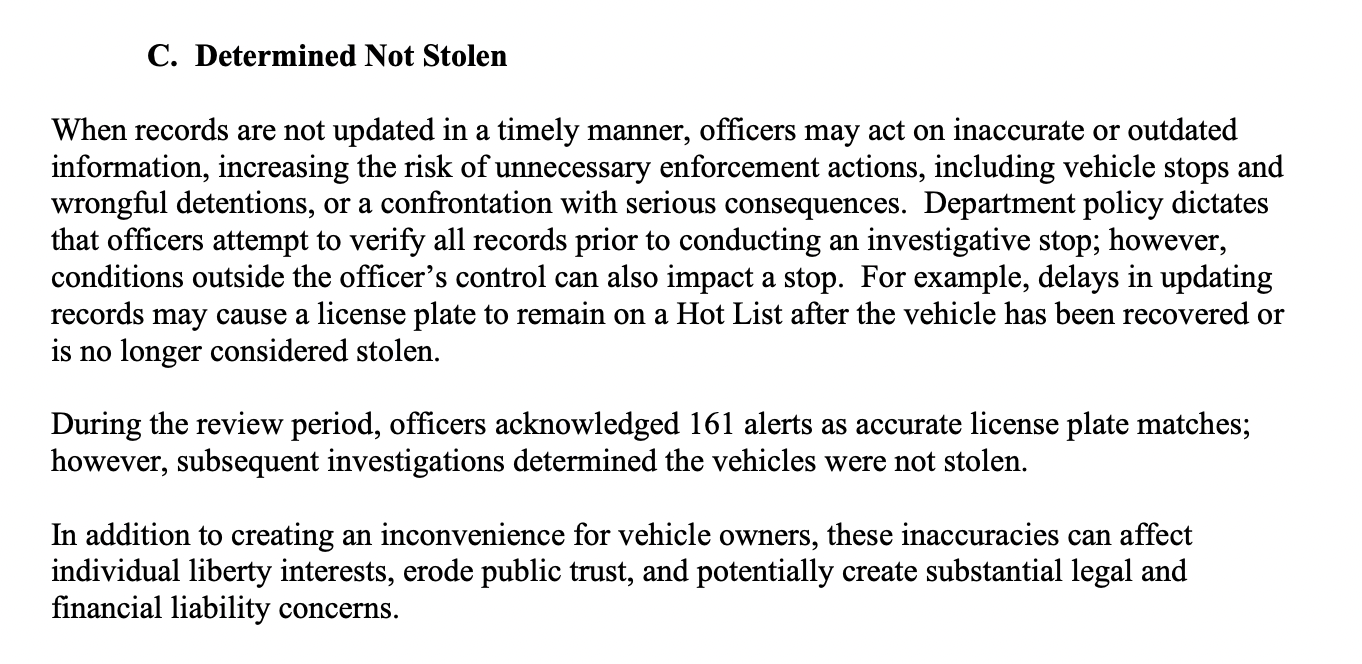
“During the review period, officers acknowledged 161 alerts as accurate license plate matches; however, subsequent investigations determined the vehicles were not stolen,” the report reads. “In addition to creating an inconvenience for vehicle owners, these inaccuracies can affect individual liberty interests, erode public trust, and potentially create substantial legal and financial liability concerns.”
The report notes that this happened because of “inaccurate or outdated information, increasing the risk of unnecessary enforcement actions, including vehicle stops and wrongful detentions, or a confrontation with serious consequences,” and that in many cases, license plates remained on a hot list after a stolen vehicle had already been recovered or was reported as not stolen, meaning the cops are in some cases pulling over the lawful owner of the vehicle.
Notably, the report states that when police get an ALPR hot list hit, the department generally considers any subsequent action to be a “high-risk” stop, meaning the risk of confrontation or potential danger is greatly increased from routine traffic stops for running a red light or speeding.
“When a license plate matches with a vehicle of interest on a Hot List, an alert will appear on the police vehicle’s Mobile Digital Computer,” the report reads. “Often, officers will approach the vehicle with extreme caution or conduct a ‘high-risk’ stop. This involves calling for back up, air support, and a supervisor and ordering the suspect out of their vehicle.” The report says, “department policy requires officers to attempt to verify the accuracy of the ALPR alert prior to conducting a stop,” but that often does not happen. The report also states that, on the vast majority of hot list hits, no action is taken by police meaning that specific people are being subjected to tracking and surveillance for no readily discernible reason. In the two-month audit period, 5,911 different license plates were tracked. No action was taken against 4,575 of those cars.
The LAPD said in response to the report that cars improperly flagged as stolen “generally result from the timing of record updates outside of the Department’s control, such as delays by another jurisdiction or a vehicle owner in clearing a plate from a Hot List after a vehicle has been recovered or is no longer wanted.” In other words, LAPD is often relying on other police departments to remove license plates from a hot list, highlighting the problems with networking different surveillance systems together.
The LAPD OIG report, which appears to have directly led the LAPD to allow its Flock contract to expire, studied the use of three different ALPR systems the department has been using, including static, pole-mounted cameras from Motorola and Flock and cameras in police cruisers made by Axon. In total, the department has nearly 2,000 ALPR cameras; LAPD accesses data for both Flock and Axon systems through Flock’s backend thanks to a data sharing partnership between Axon and Flock, according to the report. The report said the department was able to recover 337 stolen cars during the two months and that ALPR data led to 74 arrests total.
Both the OIG and the LAPD determined that the ALPR system needs to be reconsidered. The OIG suggested that the LAPD “suspend the deployment of new ALPR cameras and the execution of new ALPR-related contracts pending public input and a broader reassessment of vendors and data practices” and “strengthen oversight of ALPR data access.” The LAPD allowed its Flock contract to expire over the weekend, and said it would not enter into new contracts until going through a full audit process.
Sam Neill, the star of Jurassic Park and an actor who enjoyed an over 50-year career, has died. His family confirmed the news via an Instagram post. “Sam was surrounded by family and passed with the dignity that has characterised his whole life. The loss was sudden and unexpected but blessed by the fact that Sam remained cancer free,” reads the post, in part. “More details will be shared later, but for now, on behalf of the family, we ask that you respect their privacy as they navigate this immeasurable loss.” According to the BBC, Neill had previously been diagnosed with non-Hodgkin lymphoma, but announced earlier this year that he was cancer free. Neill was 78 years old.
Perhaps best known for portraying paleontologist Dr. Alan Grant in the Jurassic Park films, Neill was noted for his versatility as an actor, appearing in works like Possession, The Hunt For The Red October, The Piano, Bicentennial Man, The Tudors, Peaky Blinders, and Thor: Ragnarok.
Born in Belfast, Northern Ireland in 1947 as Nigel John Dermot Neill, Neill spent his childhood largely in New Zealand, where he moved in 1954. Neill began dabbling in acting in university, and his first professional on-screen role was in the New Zealand television film The City Of No in 1971. A breakthrough came in 1977 with Sleeping Dogs, considered a landmark in New Zealand cinema, becoming the first feature-length film produced entirely in the country on 35 mm film.
After that success, Neill found work in Australia before his career went even more international. In 1981, Neill starred opposite Isabelle Adjani in Andrzej Żuławski’s cult horror classic Possession. In an interview with The A.V. Club, Neill would later call the film “probably the most crazed thing I’ve ever done.” Throughout the 1980s, Neill also starred in other Australian films like For Love Alone, The Umbrella Woman, and Evil Angels, which was later released internationally as A Cry In The Dark. Neill stars opposite Meryl Streep in the film as Michael Chamberlain, a pastor wrongly implicated when his infant daughter was the victim of a dingo attack in the outback. Neill won the Australia Academy of Cinematic and Television Arts Award for his leading performance. In 1990, Neill appeared in The Hunt For The Red October opposite actors like Alec Baldwin, Sean Connery, and James Earl Jones.
But Neill’s biggest role would come in 1993 with Jurassic Park, which would become the highest-grossing film of all time upon its original theatrical run. “We sort of knew at the time that we were on the threshold of something very different and new,” Neill reflected later. “You know, it was a smart, popcorn-friendly idea, but it was also where these new technologies were coming into their own.” Neill would eventually return to the franchise for 2001’s Jurassic Park III and 2022’s Jurassic World Dominion. Also in 1993, Neill appeared in The Piano, which won the Palme D’or at the Cannes Film Festival.
Neill’s career remained consistent throughout the 2000s as he landed recurring roles in series like The Tudors, Crusoe, Alcatraz, and Peaky Blinders, in which he appeared from 2013 until 2014 as Major Chester Campbell, a main antagonist of the show’s first two seasons. In 2024, he acted opposite Annette Benning in the Peacock series Apples Never Fall. Neill was diagnosed with cancer in 2022, though he worked fairly consistently throughout this time, telling The Guardian in a recent interview that he had been in chemo for five years. He took some of the time away from film acting to work on a memoir, Did I Ever Tell You This? Though he recovered from the cancer, he seemed to have made some peace with his illness, telling The Guardianin 2023, “I’m not afraid to die, but it would annoy me.”
"Are you armed?!" the police officer screamed. "Get out of the car!"
A writer for the car-news site The Drive describes how "a technological chain linking surveillance cameras, AI, and law enforcement... led to me and my wife being surrounded by police, hands on their guns, in a Kohl's parking lot in suburban Minnesota."
After dropping off our Amazon returns, we'd just gotten back in the Range Rover and reversed maybe two feet out of the spot when four cop cars came flying out of nowhere and boxed us in... The Plymouth Police Department had been tracking me for days using Flock license plate cameras, waiting for the right moment to strike, because they thought I'd stolen the Range Rover. And the reason I was ID'd as a dangerous car thief was a simple data error made 2,000 miles away in California, creating an edge case within an edge case that Flock's AI camera network was unable to handle... "The plates on this car are stolen," Officer Ganshyn said...
This made absolutely no sense. Car companies keep meticulous track of the fleets they loan out to the media. The vehicles all have special manufacturer or dealer plates that are logged every time one enters or exits... The New Jersey plates that were allegedly stolen from the LA dealer were 34 03 DTM, not 34 10 DTM. But when the police report was created and the plate was entered into Flock's system, it was just recorded as 34 DTM. Just the five large characters, no little number in the middle...
Flock's AI tech wasn't registering that non-standard little number when it began picking up the Range Rover around town... I connected the final dot. A lot of vehicles in [Range Rover manufacturer] JLR's media fleet have a New Jersey manufacturer plate with the same alphanumeric structure — 34 ## DTM — and Officer Ganshyn observed that meant it was now a nationwide issue. Anywhere a police department has a partnership with Flock, any other JLR-owned car with the same plate structure is going to get flagged as stolen. In fact, four other 34 ## DTM cars were being tracked around Minnesota that week, according to Officer Ganshyn. I was just the first one to get nabbed.
The only way to stop it would be for the LAPD to correct their initial report and update Flock's system, which Jaguar Land Rover was now racing to make happen following the phone call. Still, he warned me to drive straight home, park the Range Rover, and leave it there. If I were to cross into the neighboring town, I'd probably get flagged again and go through this entire ordeal again with a different set of officers. His parting words were ominous: "You're lucky we're in Plymouth. If you were in Minneapolis, they definitely would've come at you with guns drawn."
Ironically, even the original license plate wasn't stolen either, the article points out. It was reported misplaced during a Los Angeles photo shoot, and "The corporation had to report the plate as lost to law enforcement," according to the police report — and even then, the plate "was reported as NJ 34DTM instead of NJ 3403DTM."
The author's conclusion? "Once these systems have you in their crosshairs, there's pretty much only one way it can go... A simple data-entry error, magnified and broadcast nationwide by a growing surveillance network operated through an opaque partnership between a private company and public agencies, led police to identify me as a car thief and set up a sting to take me down. I mean, they even had a drone flying overhead during the 'bust'...
"Thank God our kids weren't with us."
Thanks to long-time Slashdot reader sinij for sharing the article.
 Log in